


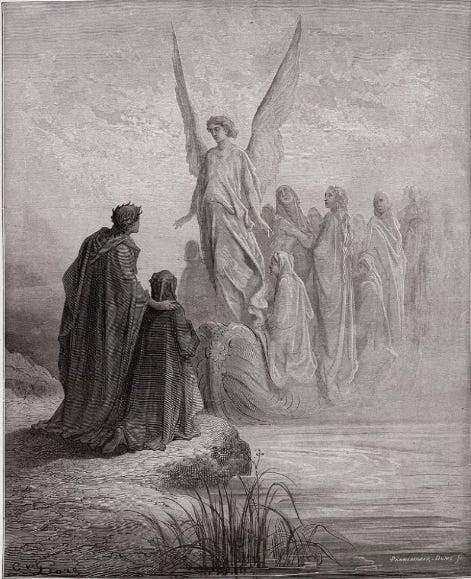
Dante is never more self-consciously the poet and the artist, conversing and musing with his fellow artists, than in the second major section of his great poem, the Purgatorio. If the Inferno was the favorite of 19th century romantics, the Purgatorio has been claimed by modernists, especially the poets and artists.
It is also the part of the Comedy most concerned with the hope of earthly politics, as Dante encounters striking figures whose stories reveal qualities of both civic virtue and vice. In the Purgatorio, the poem’s scene widens out beyond Florence (the focus of the Inferno) to all of Italy viewed as a landscape of little kingdoms.
And most importantly: of the Comedy’s three dreamworlds, only the Purgatorio unfolds in real time, allowing for hope and change.
We’ll read the Purgatorio together, three cantos per session, on Tuesdays at 2-3:30 PM EST, starting May 5.
To register for the Purgatorio class, please click here.
There is a tuition charge with scholarships available.
Text
For our common reference, I recommend we use the well-received translation by Jean and Robert Hollander. It has extensive notes and includes the Italian text. The translation is both accurate and readable.
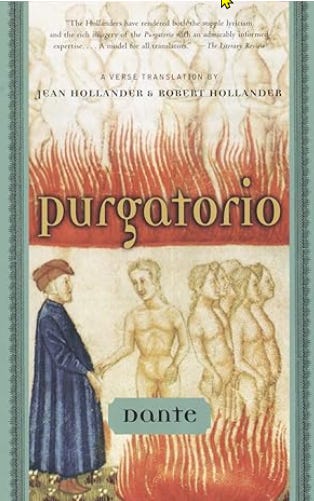
If you’d like to explore versions which bring out more of the poetry, you might look those by at W.S. Merwin, D.M. Black or Jason Baxter.
In our class discussions, I will make it a point to always refer to the line numbers of the Italian text so that if you prefer another version over the Hollander, that should work fine.
Schedule
(All 10 sessions will be 90 minutes and will be recorded.)
We’ll meet via Zoom on Tuesday afternoons 2-3:30 PM EST.
May 5
Canto 1: Morning; Venus; the four stars; Cato; the rush and the dew
Canto 2: The ship of souls; the angel pilot; Casella’s song; Cato’s rebuke
Canto 3: Dante’s shadow; the Contumacious; Manfred
May 12
Canto 4: The ascent; the sun’s course; Belacqua; the Lethargic
Canto 5: The Penitents of the last hour; Jacopo del Cassero; Buonconte da Montefeltro; La Pia
Canto 6: The power of intercession; Sordello; the disorders of Italy and Florence
May 19
Canto 7: The greetings of Virgil and Sordello; the Valley of the Princes
Canto 8: The guardian angels; Nino Visconti; the three stars; the serpent; Conrad Malaspina
Canto 9: The dream of the eagle; St. Lucy; the gate of Purgatory
May 26
Canto 10: The First Terrace; the sculptured wall; examples of humility; the purgation of pride
Canto 11: The Lord’s Prayer; Omberto Aldobrandeschi; Oderisi; Provenzan Salvani
Canto 12: The figured pavement; the proud brought low; the angel of humility
June 2
Canto 13: The Second Terrace; examples of kindness; the purgation of envy; Sapia
Canto 14: Guido del Duca; the Arno; the degeneracy of Romagna; examples of envy
Canto 15: The angel of mercy; spiritual partnership; the Third Terrace; visions of gentleness
June 9
Canto 16: The purgation of anger; Marco Lombardo; human degeneracy; the Church’s misguiding of the world
Canto 17: Visions of anger; the angel of peace; disordered love as the principle of sin
Canto 18: The exposition of love; the Fourth Terrace; the purgation of sloth: examples of zeal and sloth
June 16
Canto 19: The dream of the Siren; the angel of zeal; the Fifth Terrace; the purgation of avarice and prodigality; Pope Adrian V
Canto 20: Examples of generosity; Hugh Capet and the Capetian Dynasty; examples of avarice; the earthquake and the Gloria in Excelsis
Canto 21: Statius; the completion of his penance; his greeting of Virgil
June 23
Canto 22: Statius’ indebtedness to Virgil and his conversion; the Sixth Terrace; the purgation of gluttony; examples of temperance
Canto 23: The wasted form of the penitents; Forese Donati; his warning to the women of Florence
Canto 24: Bonagiunta; “the sweet new style”; the second tree; examples of gluttony; the angel of temperance
June 30
Canto 25: The generation of the body and creation of the soul; the Seventh Terrace; the purgation of lust; examples of chastity
Canto 26: Dante’s shadow on the flames; examples of lust; Guinicelli; Arnaut
Canto 27: The angel of chastity; the passage through the fire; the dream of Leah; Virgil’s last speech
July 7
Canto 28: The Earthly Paradise; the fair lady and the stream; the seeds dispersed on the earth
Canto 29: The walk by the river; the pageant of revelation
Canto 30: Beatrice on the chariot; the disappearance of Virgil; Beatrice’s rebuke of Dante
July 14
Canto 31: Dante’s confession; the passage through Lethe; Beatrice unveiled
Canto 32: The wheeling of the pageant; the great tree; disasters to the chariot
Canto 33: Beatrice’s promise of a deliverer; the sanctity of the tree; the passage through Eunoe