


Last issue I was talking about how many of us rediscovered mutual aid during the Covid-19 pandemic. And how the ongoing climate disasters are unhappily providing even more occasions on which we’re relearning how to practice this ancient social response.
But mutual aid, which is usually thought of as a temporary effort, can also work as a catalyst, an onramp to creating new communities and movements.
Quoting again author Dean Spade, little communities of mutual aid are an opening to “new ways of living where people get to create new systems of care and generosity.”
What would these new systems look like? We don’t have the words to describe it because our neoliberal culture lacks even a vocabulary of care—a sign of the degree to which we now live in a shared condition of carelessness.
Putting it another way, we are suffering largely because we live in systems of organized loneliness, as the authors of The Care Manifesto point out. We are “uncaring by design,” struggling in a culture of wealth supremacy which “leaves most of us less able to provide care as well as less likely to receive it.” Care today has been relegated to self-help, something we’re supposed to buy ourselves.
This is the system which must be broken. Our care infrastructure must be demarketized in order to resocialize it—which partly means, returning it to the way it worked for centuries before becoming commodified. This process will require many more examples of care-in-practice, working demonstrations of the system we need. (Thus my little crusade recently here around social co-ops and a social economy.)
Where the prospect of a new politics enters the equation here is when we create these new caring communities with a sharing infrastructure.
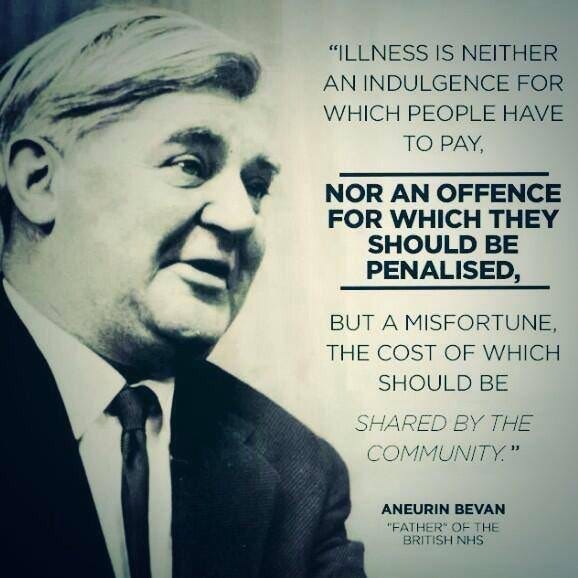
Ever heard of the Tredegar Workmen’s Medical Aid Society? A relatively small local project, it was the historic seedbed of Britain’s National Health Service, the latter cause championed famously by British Labour Secretary Aneurin “Nye” Bevan, a chap whose history is fascinating. (His fellow Welsh citizens voted Bevan the #1 Welsh person of all time.)
The point here is: whether we ever get to universal healthcare in the U.S., we know we need more local aid societies—circles of care—now.
What would the core features of these local circles of care look like? Their features would include:
an organized system of mutual support;
a public space;
shared resources;
community control.
And how would these small local efforts get us to a new politics? I’d suggest it will emerge from two dynamics.
First, at the simplest level, a circle of care is one way ordinary citizens can establish a form of belonging and shared responsibility—whether you are receiving care or helping to provide it. You become a member of a group which is interdependent in an ongoing, face-to-face quest with a meaningful purpose—to keep each other well.
Second, this kind of membership is a form of empowerment for citizens whose learned helplessness means they are accustomed to thinking they lack any meaningful power whatsoever.
Do we still possess enough social imagination to remake the world in this way?
Some of us not only think so but working to lay the foundations.
Please feel free to share your thoughts and comments!
See you next time—peace.