


“The ceremony of mourning ‘acts like a varnish, protects, insulates the skin against the atrocious burns of mourning’. When there are no rituals to act as protective measures, life is wholly unprotected.” (Byung Chul Han, The Disappearance of Rituals)
What follows here are a few sketches from life, an extension of some thoughts offered earlier this year in a post called
Trumpism as Grief Culture

I have not read Hillbilly Elegy, the memoir of J.D. Vance, a son of Appalachian culture whose successful escape from that world (and from his troubled family) put him on track to political fame. The book’s fate has been to become an insider’s explanation of Blue America and the forgotten-man culture of Trumpism
The common thread here is my suspicion that many of us share an unrecognized condition: the existence of “unprocessed” or buried grief amidst a neoliberal culture whose competitive energies push against being interrupted for “unproductive” occasions of public lament.
Like contamination beneath a plot of land, I think of buried grief as awaiting discovery after which it obstructs anything new until it can be “remediated.” Remediation would mean, in the jargon, closure, especially the kind of communal closure that comes from rituals.
In rituals of mourning and lament, it is the community that mourns, that imposes the mourning upon itself, as we have learned from philosopher Byung Chul Han.
The condition I’m exploring here is more than a lack of closure. It is partly our culture’s well-known avoidance of death and dying. But there’s even more.
Here are four historical moments of destabilizing grief, most of which have enfolded over decades, all of them based in common experiences, all of them still quietly contaminating our shared life:
The grief of those affected by the toll of America’s perpetual wars over the last two decades (over 7,000 deaths in Iraq and Afghanistan), as well as the annual average of 250 self-inflicted deaths by service members.
The grief of the COVID-19 pandemic, a time when a profound human impulse—to mourn family members in public funeral ceremonies—was put aside by something very like a state of emergency;
The grief of the well-documented decline in living standards (and social status) for a large part of the American middle class, beginning in the 1980s;
The grief of losing some 4 million family farms in this country between 1940 and 2012, representing perhaps 25 million people leaving the land and thus removing from it and themselves, as Wendell Berry reminds us, their “love, care, skill and work.”
Somehow, none of these shared catastrophes—all of them enormous in scope--have led us to instigate occasions of public mourning on a national scale.
What this means in a society which has allowed its social practices to diminish into instrumental and economic relations is that we lack grief communities which could bring forgiveness and reconciliation.
An experience years ago left me thinking about how older cultures—in this case Catholic culture—once offered powerful religious practices for community grief.
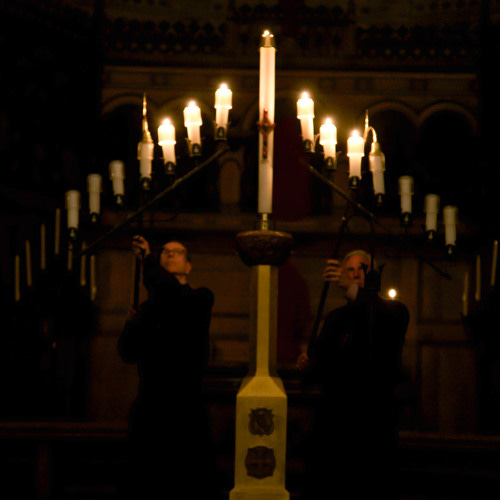
Chicago, 1985
Tenebrae is a Latin word for “shadows” or “darkness.”
I first attended a Tenebrae service while living in Chicago. I had discovered a century-old Catholic church, St. John Cantius, in the historic Polish neighborhood which runs along Milwaukee Avenue. A friend knew of my curiosity about the old rites of the Church and suggested I attend this particular service which is observed at the conclusion of Lent, just before the Easter Triduum of Good Friday, Holy Saturday, Easter Sunday. He did not mention how spiritually arresting it would be.
Entering the dimly lit sanctuary, I took a booklet of readings drawn from the penitential Psalms and the Book of Lamentations. As I slipped into a worn wooden pew, I noticed the altar was stripped bare with only a candle stand (called a “hearse”) of fourteen brown and one white candle, all lit.
The men of the church’s Gregorian choir were seated around the altar. As the service began, an antiphon chant from a single voice rose up, the opening words of Psalm 69, “The zeal for Thy house has consumed me, and the reproaches of them that reproach Thee, fell upon me.”
Tenebrae is an ancient monastic office of lamentation which commemorates the darkest moment in the Easter cycle, the night of the betrayal of Jesus and the crucifixion. Quite unlike anything I had ever experienced before in a church, I felt the service taking us, the congregation, deep into the mystery of grief, abandonment, and agony.
The coming darkness is made palpable by the gradual extinguishing of a candle after each of the readings until only the single white candle remains.
Then a moment of “weird Catholicism”, as some people refer to these ancient rites, happened. After a few seconds of quiet in the near-darkness, the congregation began stamping its feet on the floor, recreating with the noise (a strepitus in Church Latin) the earthquake which Scriptures record at the point of Christ’s death. The eerie clatter lasted for less than a minute.
Finally, the last candle–symbolizing the light of Christ–is placed out of sight behind the altar, suggesting the apparent victory of evil for the moment. The church is now in almost total darkness, in tenebris. In this mood, unrelieved by any joyful music or parting words of hope—Easter joy is still yet to come--the congregation files out in what felt like a truly rare kind of contemplative silence.
I realized I had just experienced a liturgy, a “public service connected to the divine”, which was very foreign to our untragic sense of life and its learned helplessness in the face of grief.
Especially when celebrated in a beautiful old basilica and with a Gregorian choir, I imagined Tenebrae drawing upon indigenous European roots, almost lost by now, in order to celebrate an annual observance at which the Catholic community offers up their shared grief within the mystery of our mortality and losses.
Tenebrae services are still offered by many churches—Catholic and Protestant--today. At home I sometimes try to recall this moment by listening to a choral setting of Tenebrae, either Palestrina’s Maundy Thursday Tenebrae and Thomas Tallis’ Lamentations of Jeremiah, both of which I’ve found to reach great depths of solitude.
Let me turn now to my first category of grief, that felt by those touched by our perpetual wars. I begin by reflecting on an experience I had in the former U.S.S.R.
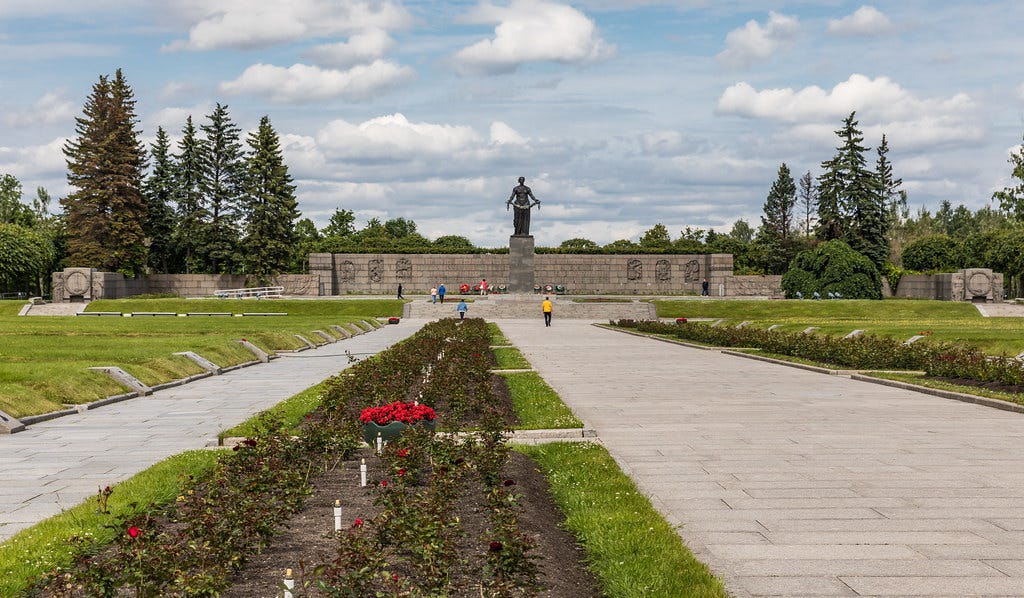
Piskaryovskoye Cemetery, Leningrad, 1978
In the summer of 1978, I was restless to leave grad school for a new adventure—say, learning Russian. So I signed up for a two-month camping and driving tour of the U.S.S.R.
I had read a bit about Russia’s horrendous experience of the Second World War. My first closeup glimpse of its lingering aftermath occurred early on when we reached Leningrad, as it was still called in those days. At one moment, I wandered away from the tour group on a whim. Strolling down a side street only a block or two away from the famous boulevard Nevsky Prospekt, I spotted an old apartment building, still standing but ripped in half and exposed to the street like a giant gaping wound.
I guessed its ruined condition dated back to the German bombing campaigns during the siege of Leningrad, the infamous “900 days” between 1941 and 1944. Thirty-four years later, it was clear the Soviet regime had still not been able to repair all the destruction caused by what our government tour guides referred to simply as “the Fascist invader,” a kind of catchall explanation for the dilapidation and ruin still found in many places.
Certainly the apocalypse of the largest invasion force in the history of warfare, along an 1,800-mile front, still haunted every Russian of age in those years, especially the older Leningraders who survived.
For the three-year duration of the city’s siege, starvation was the main killer, with the worst period that of January through March 1942, when around 100,000 died each month until the streets became littered with bodies. For their part, the living dealt with thirty-below temperatures without heat or light. Leningraders reportedly ate their pets and even the bark off the trees under the relentless force of the German campaign to destroy this symbolic city, the birthplace of the Russian Revolution in 1917. Over 100,000 bombs were dropped on the city, and the final toll from starvation was over 641,000. Altogether, estimates are that one million died in the greater Leningrad region.
After the blockade ended, the sheer quantity of corpses overwhelmed the Russian soldiers assigned the task of digging the graves: they eventually resorted to dynamiting open the frozen earth in order to complete the task.
The Piskarevskoye cemetery contains about 420,000 civilians and 50,000 soldiers buried in 186 mass graves. We walked alongside these long bunkers at the end of which the only inscription was a year: “1941”, “1942”, “1943”.
I have a photo of the wide plaza in front of the Mother Motherland statue where I remember we could hear over the loudspeakers the dirge-like strains of Shostakovich’s Seventh Symphony (the “Leningrad”), a musical piece championed by Stalin himself.
On June 8, 1996, Russian president Boris Yeltsin established June 22 as the annual Day of Remembrance and Sorrow to commemorate Operation Barbarossa, the Axis invasion of the U.S.S.R. Russians also observe Victory Day on May 9 in honor of the Russian victory over Nazi Germany. (The Russian term for the Second World War is “the Great Patriotic War.”)
It is difficult to comprehend the Russian war losses: 27 million dead, of which two-thirds were civilian. An older Russian we befriended during the 1978 trip related that even almost four decades after the end of the war, most newspapers still had a special section for those seeking information about lost family members from those years.
Privately, Russian funeral traditions include a three-day period of grieving in the family home, along with the practice of covering every mirror with black cloth and stopping all the clocks. Open caskets are more common than is our practice and visitors often place items inside, such as personal effects and money.
Mourners form a circle around the casket, taking turns to place flowers inside and sometimes to lean down and kiss the departed.
Moreover, grieving does not end with the funeral. Memorial days for the deceased are held periodically in later years and are occasions for collective mourning.
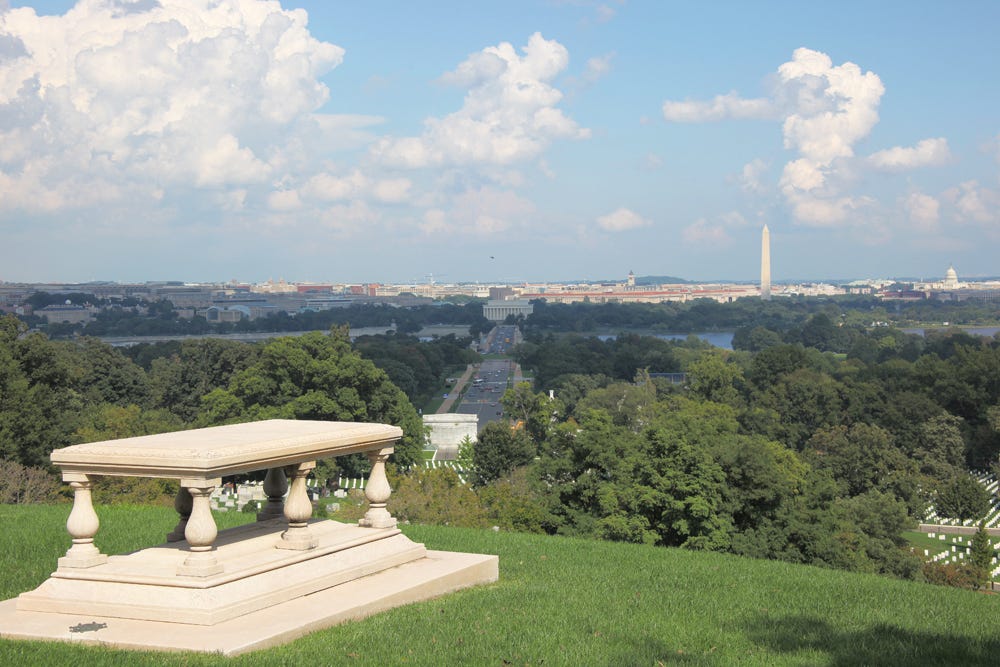
Arlington National Cemetery, 2024
I began this visit by making a long stroll past thousands of white grave markers as I went up the hill to Arlington House. This former home of Robert E. Lee sits at one end of Arlington National Cemetery whose 624 acres make it almost ten times the size of Piskaryovskoye. From the front porch, the view back toward the city of Washington D.C. is majestic, one which Lee must have enjoyed until his refusal of the Northern Command in 1861 inevitably meant he and his family had to abandon the house and its slave quarters.
The land was confiscated from the Lee family and became a national cemetery on May 13, 1864. After the Civil War, the southern part of the property was initially used as a “freedman’s village” with rental houses for several thousand freed slaves who farmed the estate and received training. Segregated burial areas were used until President Truman changed the practice in 1948.
Over 400,000 U.S. servicepeople are buried at Arlington, representing conflicts from the Civil War through Afghanistan. Today the cemetery holds two dozen or more funerals daily, an average of almost 7,000 annually.
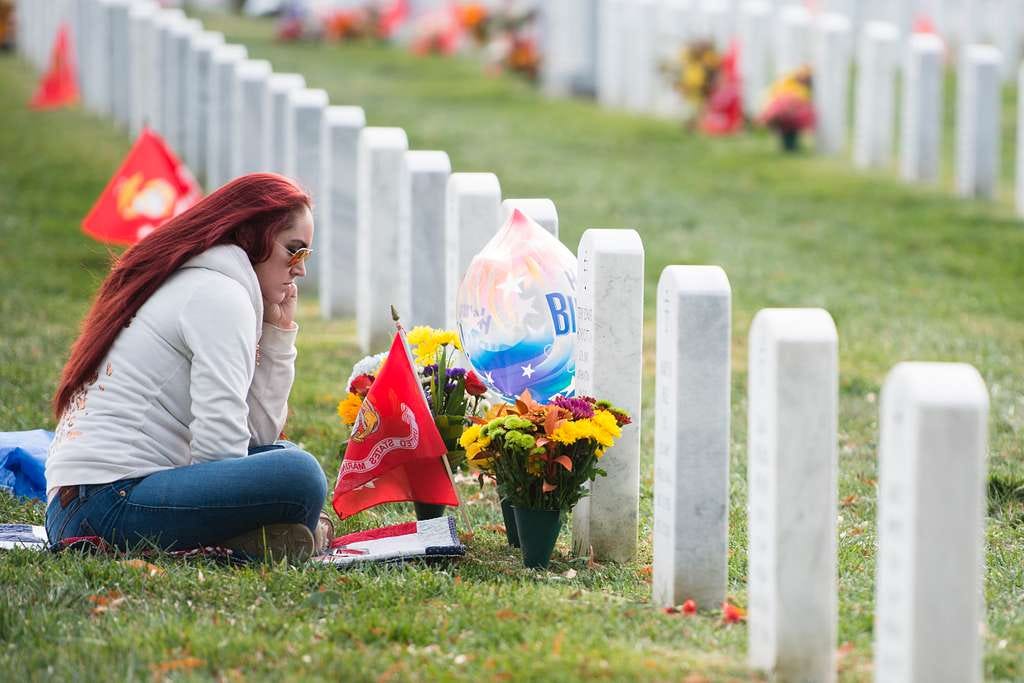
Its 70 sections represent different conflicts in U.S. history but it is Section 60—service members who died in Iraq and Afghanistan, starting in 2001—which has revealed something about uncontrollable, unmanageable grief.
In a time when war is mostly invisible by design, Section 60 has been a place where you might know we’ve had a war going on. This section is only 14 acres of the 624-acre cemetery, with just over 900 graves. As author Robert M. Poole pointed out in his book Section 60: Where War Comes Home, it is one of the few places in America where it’s considered normal to talk to the dead.
Speaking to National Geographic magazine in 2014, the author remarked, “There’s the community of the dead under the ground, and the community of the living aboveground. And people have no hesitation about carrying on conversations with dead brothers, husbands, fathers, or mothers buried there. It’s like they’re still alive. Why people do this I don’t know.”
What also struck Poole in his research was the rawness of emotion in this part of the cemetery, similar to the atmosphere around the Vietnam Veterans Memorial in its first years after being installed in 1993.
He noted that Section 60 was a place where family members would camp out, laying out a blanket and sleeping on the grave of their lost brother, husband or son.
People were also bringing a strange array of items to place on the grave markers: report cards, sonograms of unborn children, love letters, empty rifle cartridges, baseball caps. Comrades who were present at a friend’s death observe the custom of leaving on the headstone a quarter coin or a penny in the case of someone with whom they went to boot camp.
The emotional rawness is perhaps also related to the number of deaths caused by what Poole calls “the signature weapons of our most recent conflicts”—i.e., suicide bombs and improvised explosive devices (IEDs), the latter causing more than 2,500 deaths in Iraq and Afghanistan. This fact may be related to something I noticed when I recently walked through this section: the numerous graves of Navy SEALs, Army Rangers, Green Berets, para-rescue airmen and helicopter pilots.
As Poole notes, the term IED comes from the conflict in Northern Ireland. These fearsome devices so damage and disfigure victims that medical examiners frequently recommend the families do not view the body, thus inevitably blocking out an important part of the healing process.
For a number of years, as Poole recounts, grieving families ignored the cemetery’s no-alcohol rule in order to drink at the gravesite, sometimes pouring out part of a beer on the ground as though re-enacting a funeral practice out of Homer’s Iliad.
It’s important to note that Arlington National Cemetery is not part of the National Park Service but rather has been operated by the Department of the Army since its inception. Thus it’s not surprising that some of the more plaintive mourning practices observed in Section 60 drew the Department to begin exerting tighter controls over grieving visitors. Weekly “sweeps” of the section are now routine, with strict rules as to what kinds of items and interactions are allowable. It is now the prerogative of the Army’s Center of Military History to determine the disposition of the miscellaneous items, whether to “preserve, throw away, leave in place.”
Just as with the elaborate and precise choreography of the guard in front of Arlington’s Tomb of the Unknown Soldier, the military always wants—perhaps desperately—to signal its firm control over all aspects of the horrific events which its actions have unleashed. Too much public expression of raw emotion, however needed by those caught up in grief, can challenge that control or even contribute to undermining its reasons for existing.
On my recent visit, Section 60 was typically quiet except for the loudspeaker at a distant Marine Marathon event I could hear across the cemetery in the distance. As I walked through the long aisles of grave markers, I spotted roughly a dozen floral arrangements. Approaching the main road back to the entrance, I took a look back and saw a young woman seated motionless on the ground before a grave marker, bent over in what looked like a praying position.
If we must have community in order for our rituals of lament to be efficacious, then we are forced to confront the terrible dilemma which I quoted author Bill Kauffmann on in my earlier post: “You can have empire—or you can have your hometown. You can’t have both.”
In future posts here, I will take up the other three historical moments of “frozen” grief.
See you next time—peace.
Beautiful stuff, Elias. I certainly ascribe to the notion that we as a nation have not been able adequately to mourn the losses of the Covid pandemic. I also agree that wars of recent memory, all in the 2000s, are of a different nature, requiring yet a different kind of lamentation. I am finally of the opinion that this has been going on since Reagan, who began the process of rewriting history that is only now seeing its full flowering under the Trump regime.
I find rich and sensitive reflections here on your experiences at three places where public grief is encouraged or suppressed. I've never been to a Tenebrae service. I think the participation in creating the "earthquake" there would often be powerful, almost like the rage generated at some public funerals that regimes sometimes try to abort.