


I attended a spiffy event a few months ago at Halcyon House in the Georgetown neighborhood of my newish home, Washington D.C. This historic Federal-style mansion is the gorgeous homebase for a nine-year old startup incubator named for the building.
The Halcyon organization’s annual cohorts of entrepreneurs—which include many social entrepreneurs, not just Silicon Valley bros with another new app—are an international and racially diverse mix of very talented people.
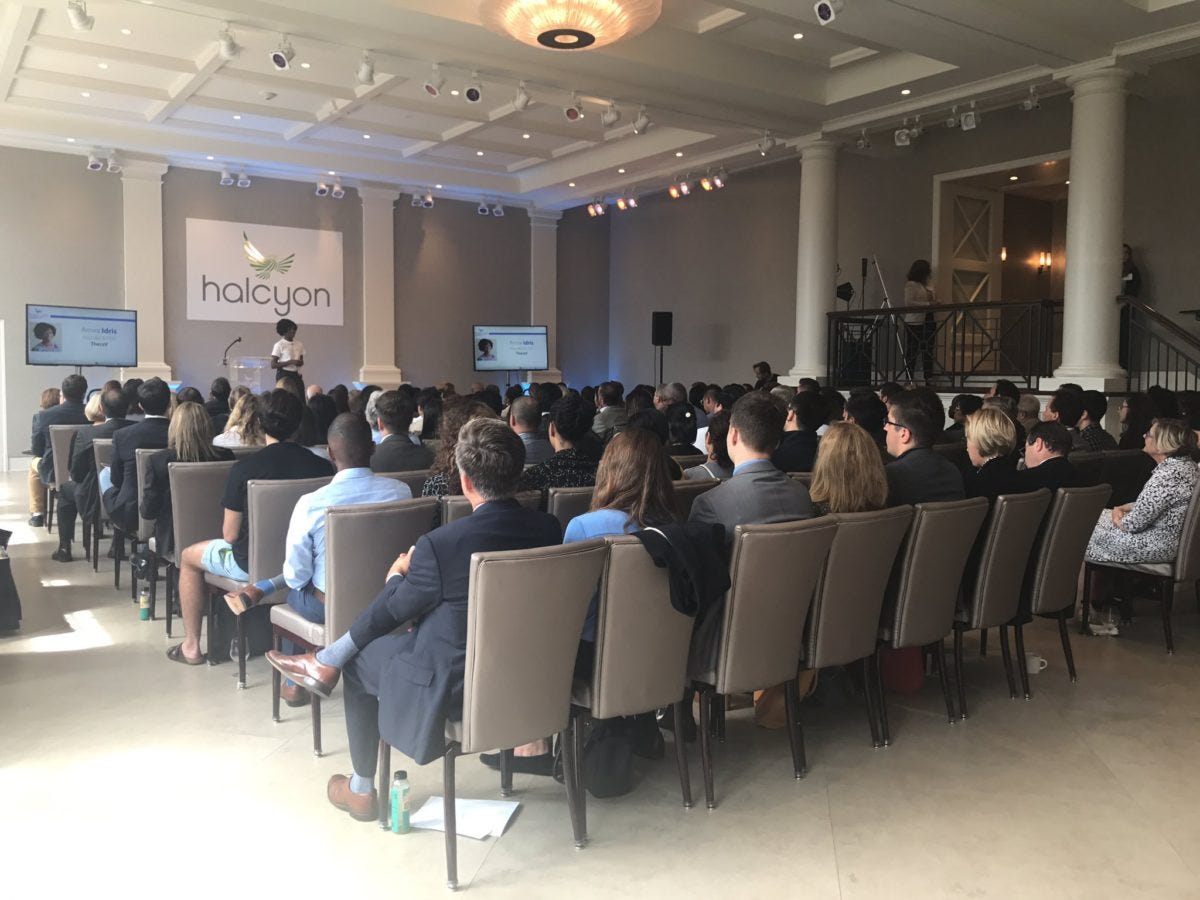
In 2022, Halcyon supported 60 ventures and 76 fellows from 31 countries around the world, providing support for ventures in agriculture/food security, education, access to healthcare, and climate resilience, among other sectors.
Not many Halcyon entrepreneurs come from spiffy backgrounds, of course, which is why the program offers some financial support and a cash prize for a winning pitch.
Even so: glossy programs like the Halcyon incubator are simply not accessible for many low-income people, even if they have a passion for creating a business—which points to a larger problem. Among the typical barriers to entry are the need for 1) familiarity with business culture and lingo generally, including business classes; 2) access to a laptop; and 3) skills in creating spreadsheets and other documents.
Another frequent and often bigger barrier is a state of psychological readiness that allows the entrepreneur to engage in the program recovered from any prior trauma, disabilities, or negative life experiences. Returning citizens, “overcomers” (people in various kinds of recovery—from addictions, domestic abuse, etc.), and immigrants are usually struggling simply to become work-ready, much less ready to create and build a new business.
But here’s where my Chicago friend Camille Kerr comes in, one of the more determined and capable people you will ever meet. Camille is the consultant who moved to Chicago in 2018 in order to launch a co-op business with returning Black worker-owners. Some local community organizers helped her recruit five women and one male for a commercial food service—now famous among restorative justice advocates—called ChiFresh Kitchen.
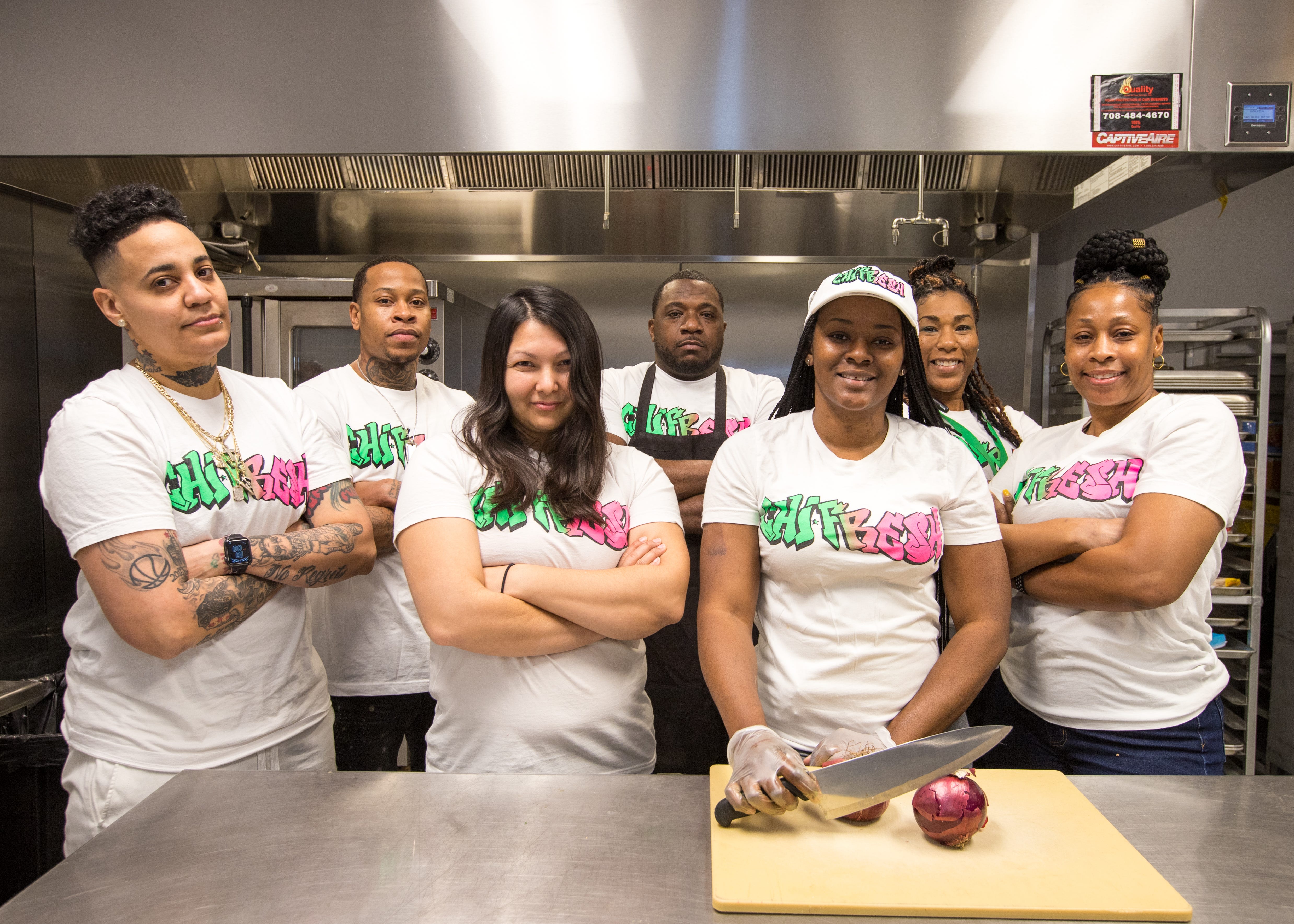
In an interview for my newsletter Ownership Matters, I asked Camille how the group reacted when she first described her idea. She said she got an an enthusiastic reaction:
Because there were NO barriers. Barriers are killers. The new employer tells them, You’re perfect for this job. And then 90 days later the background check comes in and you’re immediately fired, you know?
The reason we focus on formerly incarcerated people is not because there’s anything innately good or bad about them. It’s just because that’s where the barriers are. These are beautiful humans that are facing overwhelming barriers. So let’s get rid of those things.
They’re people, they’re just people who’ve dealt with shit, you know? I’m really close with some team members, a little less close with others. Some of us have personality stuff in common, and each of us has different talents. All of our members had a hard, hard childhood. If I grew up in that situation, I’d be in exactly the same place. It’s just circumstances.
Kerr, who works pro bono with the business, notes that ChiFresh was not quite ready to launch in 2020 when the Covid-19 pandemic hit. But they chose to start up anyway, given all the food orders they were already receiving via their Chicago partners at Urban Growers Collective and the Chicago Food Policy Action Council. The co-op was immediately profitable, serving healthy meals to low-income communities, schools, and organizations hosting special events. Although they raised $150,000 to launch the business, Kerr estimates they probably could have pulled it off with $80,000—not exactly a typical startup story.
And her vision of a network of businesses supporting returning citizens is coming to life, now that ChiFresh has made a move into affordable housing with their Jumpstart housing co-op.
Such projects are getting a boost from the City of Chicago’s impressive Community Wealth Building program, a broad coalition of groups energized by a $15 million civic investment in worker co-ops, land trusts, housing co-ops, and more.
Toward the end of our interview, I commented to Kerr that the ChiFresh team members must be pretty sold by now on their new roles as worker-owners. She replied:
I think so. I remember when we were first setting up and I passed around the legal documents to make everybody worker-owners. One of the team said to me, This is great — I’ve never seen my name on a piece of paper like this before.
And it helps the ownership thing when we cut everybody a $6,000 dividend check like we did last month. That helps a lot.
Some quick hits:
“…It’s not enough to be part of a food cooperative, or to buy your groceries at Park Slope Food Cooperative, or even to be a member of a workers’ cooperative. These things must build together toward a different vision of society. All of these aspects are interconnected, so that in order to address issues of climate change or environment, or in order to address issues of the punitiveness of society, we have to think about cooperation across these dimensions. Part of the social theory intervention here is to replace what we have today, which is really a punitive paradigm, with a cooperation paradigm. From a social theoretic perspective, the idea of building toward coöperism [i.e., cooperativism] is part of an abolitionist project to displace the punishment paradigm. But it depends on having and on building forms of cooperation that would make it possible to do that.” —Author Bernard Harcourt, interviewed about his new book Cooperation in the Boston Review.
Coming soon: I’m excited about an interview my frequent collaborator Elizabeth Garlow and I are setting up with Marjorie Kelly to talk about her new book Wealth Supremacy. Kelly’s previous book, Owning the Future—an exploration of how we move from extractive to generative economies—has been an inspiration to me. After reading it, I became convinced that Kelly’s idea of getting ownership design right was a powerful key to a new way of operating.
With his charismatic manner and voice, I think of him as the Anthony Bourdain of intelligent socialism. If you haven’t already discovered him, the former Greek finance minister Yanis Varoufakis is the economics prof we all should have had. His new book Technofeudalism won’t be out until February but he’s already doing interviews about his big idea—that capitalism is dead. Its markets and profit system were killed by the tech giants, as he argues, and gradually replaced with a kind neo-feudal system of “cloud capitalism” in which the big platforms now merely collect rent from us happy and captive serfs.
For a sneak preview of the book’s fascinating (and alarming!) ideas and a taste of Varoufakis’ marvelous style of presentation, try this recent video.
See you next time—peace.
Acting in the self-interest of it's members is one of their virtues and challenges of co-ops. My electricity is produced by a co-op. It is transmitted by a different co-op. And my electric company itself which pays the transmission fees and buys the electricity, is also co-op. Being owned by its members each of these coops is most interested in providing power inexpensively to its members. As a consequence, a greater percentage of our electricity is produced from coal than almost anywhere else in the country. While the resulting Mercury pollution is tragic, that fact isn't going to persuade people to vote for cleaner but more expensive energy choices. In contrast, many for profit corporations have been forced to increasingly use renewable sources of energy by their shareholders or other outside public pressure which can be brought to bear on public companies and their CEOs. It'd be interesting to see an analysis of co-ops versus corporations in terms of emissions.