


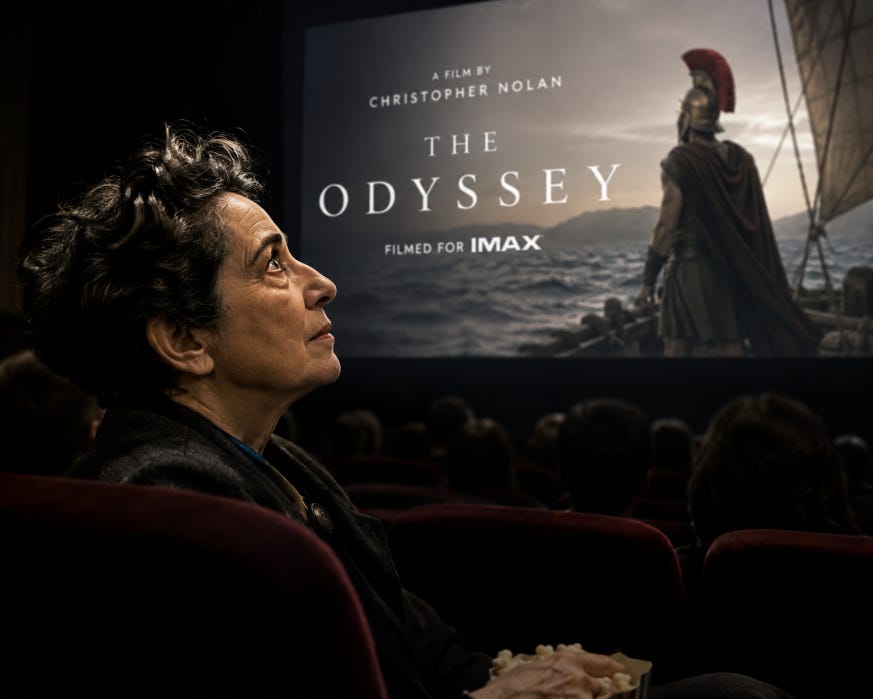
I think Odyssey fatigue has probably set in by now. Too many opinions colliding at high volume, many of them miles apart.
One usually sober friend of mine posted his view that Christopher Nolan had created “the greatest film I’ve ever seen!”
Meanwhile YouTube is overflowing with outraged denunciations, lots of them carping about casting and about “historical errors”, whatever that means in the case of a movie about mythological monsters and dream landscapes.
I have, as they say, a different take. My Homeric Greek (cough, cough) is rusty but not entirely gone yet—I’ve read quite a bit of the poem in the original. Although I’ve never believed the classical scholars somehow own the poem.
And certainly the Homeric poem’s greatness allows for many interpretations—archetypal, Freudian, Marxist, Neoplatonic, feminist (don’t forget Samuel Butler’s 1897 classic, The Authoress of the Odyssey), and so on.
Among all these interpretations, one of the most powerful and persuasive in my experience is what I am extrapolating to be Hannah Arendt’s reading. (For a deeper dive into Arendt, here’s the first of two episodes on our Lost Prophets podcast.)
Her sense of the poem, I want to argue, would not be so much one of a tale of personal self-discovery but as an education in political (or pre-political) existence.
And surprising as it may sound, we know from her work that in the ancient battle between the poets and the philosphers, Arendt (the famous political theorist) sides with Homer against Plato, the author of the founding document of political science, The Republic.
My own reading of Arendt’s views here are not based on any specific writing of hers—she never wrote anything specifically on the Odyssey—but on scattered comments (including numerous ones on the Iliad) in several of her books.
But now, as in a dream, let’s imagine we can travel to the campus of the University of Chicago where Arendt (somehow, still) has an office and keeps office hours.
A bit nervous, I knock on the door.
Hannah Arendt:
Ja, come in.
Myself:
Hello, Professor Arendt. I hope you got my letter about the movie.
HA (moving papers from a chair):
Just a moment. Please sit down. Do you smoke?
Myself:
No, thank you.
HA (lighting a cigarette):
I did receive your letter and, as you requested, I saw this film, two days ago. I believe my ears have almost stopped ringing from it.
Myself:
Ah yes, sorry. I had the same difficulty. Movies these days seem designed to derange our senses, don’t they?
HA:
This has been tried before. Richard Wagner tried to stage his operas as a Gesamtkunstwerk, a totalizing work of art which drew all forms of art together in an overwhelming experience. Although I must say this film was a far cry from the Ring Cycle.
Myself:
May I ask: did you enjoy the film?
HA:
I should probably say I understand why many other people enjoyed the film. One of the strongest emotions I feel in films of this kind is sadness—at the enormous misdirection of resources and missed opportunities, especially when presented with so monumental a story as Homer’s.
Myself:
What did you think was the major missed opportunity?
HA:
Like many other children, I loved the Odyssey as an adventure story about homecoming. When I was older I realized it concerns much more than that: it is about restoring the world of Ithaka, a place of the household, citizens, public memory and public recognition.
Myself:
You’ve written that action only becomes intelligible once it can be told as a story.
HA:
Ja, and here’s a big example of a missed opportunity: the film entirely omits Odysseus’ visit among the Phaeacians, you know, the court of Alcinous and the young Nausicaa. Four entire books in which the hero becomes a storyteller to his hosts, recounting his encounters with the Cyclopes (more than one), the Sirens, and Circe before descending into the Underworld.
Myself:
And there’s the famous moment when Odysseus, in disguise and moved by hearing the bard Demodocus sing of his deeds at Troy, attempts to hide his tears.
HA:
Exactly so—and when he narrates the episodes of his wanderings, it is that act of remembrance, a most important social force in my work, that makes his deeds intelligible again to the world and to himself. He is regaining his own identity in this process.
Myself:
It seems that at least one historic Greek virtue came through in the film—the practice of xenia or guest/host hospitality.
HA:
A film cannot really convey the depth of this idea. It’s much more than merely being nice to strangers, after all. It was a special kind of social transaction that always involved one’s own community. An act of xenia, you might say, always created a world where newcomers can appear—and possibly even participate in a common world.
Myself:
If, as you suggest, Odysseus’ mission is primarily to restore the world of Ithaka in all its dimensions, than he is more than simply a returning warrior.
HA:
Almost more like a stateman in exile, we might say. The world of Ithaka is so important to him that he declines Calypso’s offer of complete bliss: eternal life, eternal youth, freedom from suffering. Because immortality would cost him the human world.
Odysseus is a mortal being and that implies something about the political possibilities for him: as the restored ruler of Ithaka, he can make binding promises, offer forgiveness, found institutions, and tell stories. In the aftermath of war, these are the things that will give him glory among men. We are looking at the very roots of politics.
Myself:
And what did you make of Penelope’s role in the film?
HA:
We got at least a hint of the way her labor—symbolized by her constant weaving—was a work of conservation. She holds open the possibility of Odysseus’ return by refusing the premature dissolution of their shared household and its community. She represents what I have described as the need for durability in maintaining the world.
Myself:
Did the IMAX technology add anything to the experience for you?
HA:
Ach, I realized that Plato’s cave has come a long way—with the comfortable seats and the enormous “walls” on which to project the narcotizing images. But you don’t need these things.
Perhaps you need instead the “epic theater” created by my friend Berthold Brecht—a living experience among political spectators, not a passive audience. His plays interrupted illusions and exposed social appearances. All this you need now—but I’m not sure how much time you have left.
Myself:
Thanks for this conversation, Professor Arendt.
Note: Arendt’s key works used here are The Human Condition, Between Past and Future, The Promise of Politics, On Revolution, and The Life of the Mind.
Disclaimer: This imaginary conversation is not to be confused with the book, On Happiness Revolution: A Spiritual Interview with Hannah Arendt, by Master Ryuho Okawa. This author has published over two hundred “spiritual messages”, purportedly from the spirits of historical men and women and “the guardian spirits of today's living figures”, including former President Joe Biden, Vladimir Putin, and the current U.S. president.
A wonderful and entertaining application of your knowledge and learning, Professor Crim. I read much of the commentary and though my Greek comprehension is limited to an extremely poor ability with koine, I know a good story. This, from a favorite storyteller, is what got me to go.https://substack.com/@shermanalexie/note/c-307742909?r=h5mw&utm_medium=ios&utm_source=notes-share-action. Your “interview” would be another motivator. Thank you.
You've a penchant for landing great interviews, but Arendt hadn't given one in (as far as I know) over half a century. Great conversation about her reference in Between Past and Future to blind Demodocus and her ideas about remembrance and history (I had forgotten about it all). Quite an upgrade on the reviews I've read about the movie. I laughed out loud at her observation about IMAX: "Plato’s cave has come a long way . . ." And, yes, bring back epic theater! And please conjure up more of these interviews when the, um, spirit moves!