



Watching the escalating catastrophe in Gaza, we hunger to find “explainers”, people who can help us make sense of how these events happened.
As a witness to what has happened to her native state of Israel over the last several decades, Daphna Levit is an explainer with a remarkable background, including her experiences as a longtime peace activist.
Daphna is a sabra, a native-born Israeli whose family goes back three generations in that country. During the Six Day War of 1967, she was a teenaged press liaison officer, who found herself watching Palestinian refugees attempting to flee across the border. The experience, she relates, was the beginning of her long disillusionment with her country’s official narrative.
She served in the Israeli army and went on to several successful careers—in international finance, in language work, and as a peace advocate and activist in Israel. Until 2002, when her outraged sense of justice and the increasingly militant nature of her country’s politics led her to emigrate to Nova Scotia, where she now teaches and writes.
Back in February 2021, Pete and I invited Daphna for a podcast conversation about her book Wrestling with Zionism, a striking collection of essays from 21 Jewish and Israeli voices of dissent, from the birth of Zionism until today. Those voices include Martin Buber, Albert Einstein, Hannah Arendt, Noam Chomsky, Ilan Pappé, and Gideon Levy.
One of our big takeaways from this conversation was Daphna’s point about the two types of Zionism—the political kind and the cultural kind. Most Americans have heard very little about cultural Zionism—an idea shared by figures like Martin Buber, Albert Einstein, Hannah Arendt and many others—that Jewish identity should be about Jewish culture in the service of a binational society focused on peacebuilding, not on some nationalist ideology.
Here are a few sample comments from our conversation with Daphna:
“We were a largely secular society when I was growing up but we had one God—our country of Israel.”
“We were taught that our country was a miracle created by the blood of its heroes and that we can all be heroes on this magnificent battlefield for the salvation of our people. We were also taught the mantra: They all hate us.”
“About Israel’s ‘right to exist’: no other state in the world claims such a right. It turns out to mean Palestinians should recognize Israel’s theft of the land.”
“A foundation of political Zionism was the assertion that Jewish suffering was unparalleled in world history, and therefore all Nazis were inhuman monsters. Hannah Arendt challenged this narrative [in her Eichmann in Jerusalem] and was vilified for it.”
For a current explainer article, see this piece at Jewish Currents.
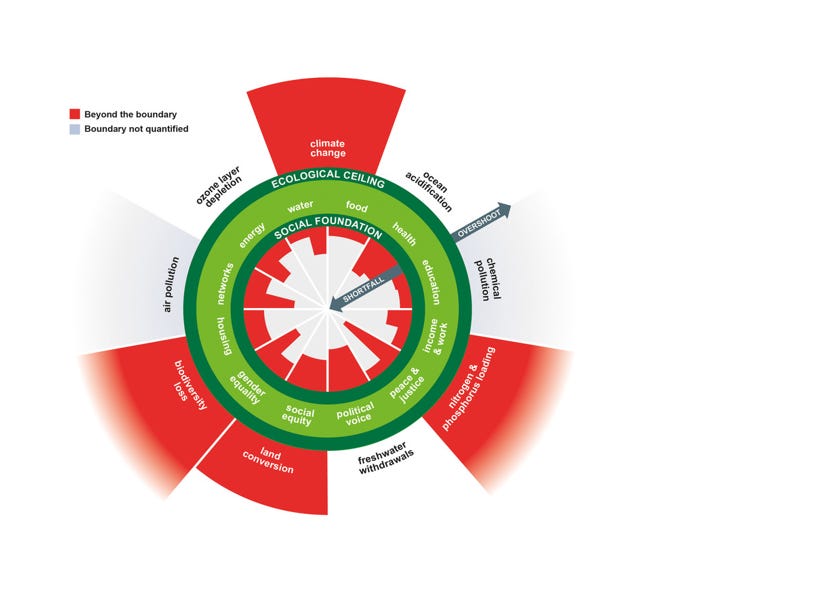
“Today we have economies that need to grow, whether or not they make us thrive; what we need are economies that make us thrive, whether or not they make us grow.”
I was not expecting to like British economist Kate Raworth’s Doughnut Economics as much as I did. For one thing, it’s surprisingly well-written, even entertaining. (And it’s a book about economics, for pete’s sake!)
Back in 2011, Raworth began to think in terms of a new mental model of the world economy, one which helps us visualize what such a model embedded in nature looks like. Her new model—which she has dubbed “a 21st century compass”—succeeds in several ways:
The image of a doughnut offers a simple way to visualize how the economy resides within an outer ring of environmental limits, life systems, planetary boundaries. We need to live in an economic system which neither overshoots our outer limits nor allows anyone to fall into the hole, i.e., below the lowest levels of livability.
The doughnut’s inner ring is our social foundation, the basics of life such as sufficient food, clean water, decent housing, access to housing, access to social support. Thus the task is to come into a dynamic balance by bringing everyone into the safe middle space without overshooting the ecological ceiling.
The image also helps understand how the economy exists within the biosphere—it’s a kind of super-organism, an open system of constant inflows and outflows. (The Earth, by contrast, is a closed system because almost no matter leaves or arrives.) Thus we can more easily grasp the fact that we live within the biosphere, not just “on the planet.”
Since the book was published in 2017, a number of governmental entities such as the country of Ireland, the cities of Amsterdam, Barcelona, and Brussels, plus numerous policy groups and educational institutions worldwide have embraced Doughnut Economics. The DEAL (Doughnut Economics Action Lab) argues that it is at the city level their new model will most effectively take hold and and work to demonstrate its validity.
For a short video of Raworth speaking about downscaling the doughnut to the city level, see here.
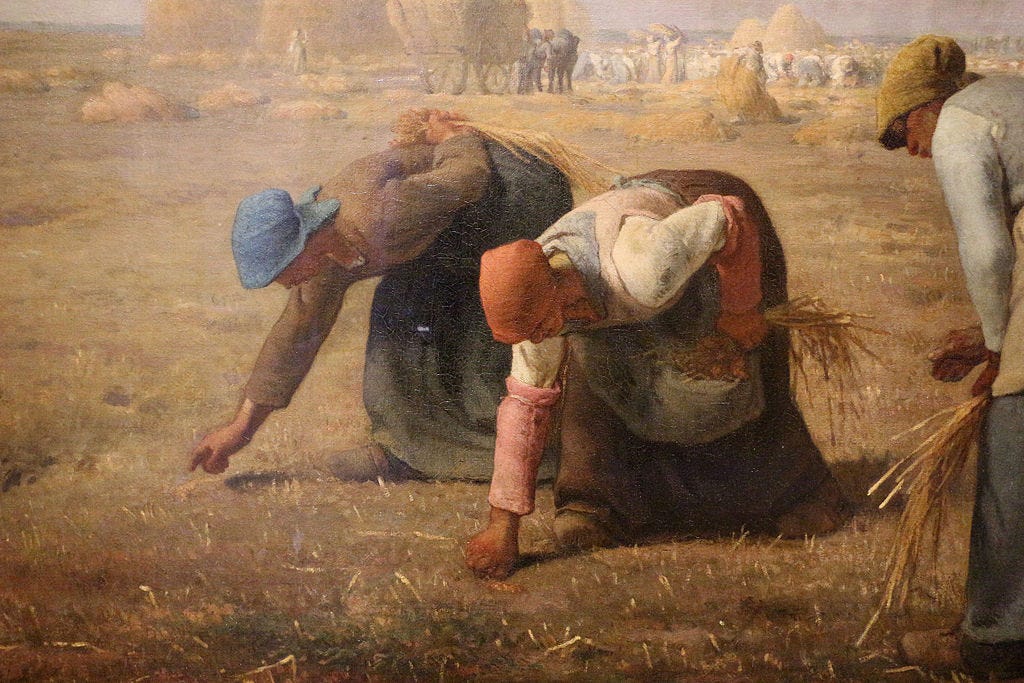
The above is the image a visitor to our Substack Welcome page encounters, a wonderful 19th-century painting, now considered a classic.
Yet the painting stirred up a controversy when it debuted at the Salon in 1857—which was not long after the revolutionary year of 1848 in France. After all, Jean-Françoise Millet’s The Gleaners did not depict mythological figures, royalty, or a biblical scene (although The Book of Ruth notes that Ruth herself was a gleaner). Merely to display a painting of the lower classes was to court a kind of nervous disfavor from good Parisian society and even suspicions of “socialism” lurking behind the artist’s intent.
This serene scene of labor strikes me as contemporary in certain ways. Not only is gleaning not obsolete today: we find large numbers of the world’s poor still living off garbage dumps and open landfills as pickers (an industry of 400,000 to 600,000 precarious workers in Brazil, for example) in search of recyclables.
Millet’s scene is also a metaphor for our precarity. We could also describe much of the clickwork of the digital economy (notably content moderation jobs—which can be horrific for your mental health) as gleaning. Unlike the case for the Brazilian landfill workers, digital gigs almost never even entitle the worker to take home and sell anything—there’s no right to ownership.
Unless you happen to be a lucky worker-owner at a platform co-op, of course.
A couple of issues ago, we promised an update on a proposed event about the Strong Towns movement. We’re calling it simply The Stronger Towns Conversation.
My friend and fellow Strong Towns fan Grace Potts and I will be hosting this event on Thursday, October 26, at noon EST. Our special guest will be writer and urbanist Allison Lirish Dean of Progressive City podcast.
To get a Zoom link, please visit the Eventbrite page!
See you next time—peace.