


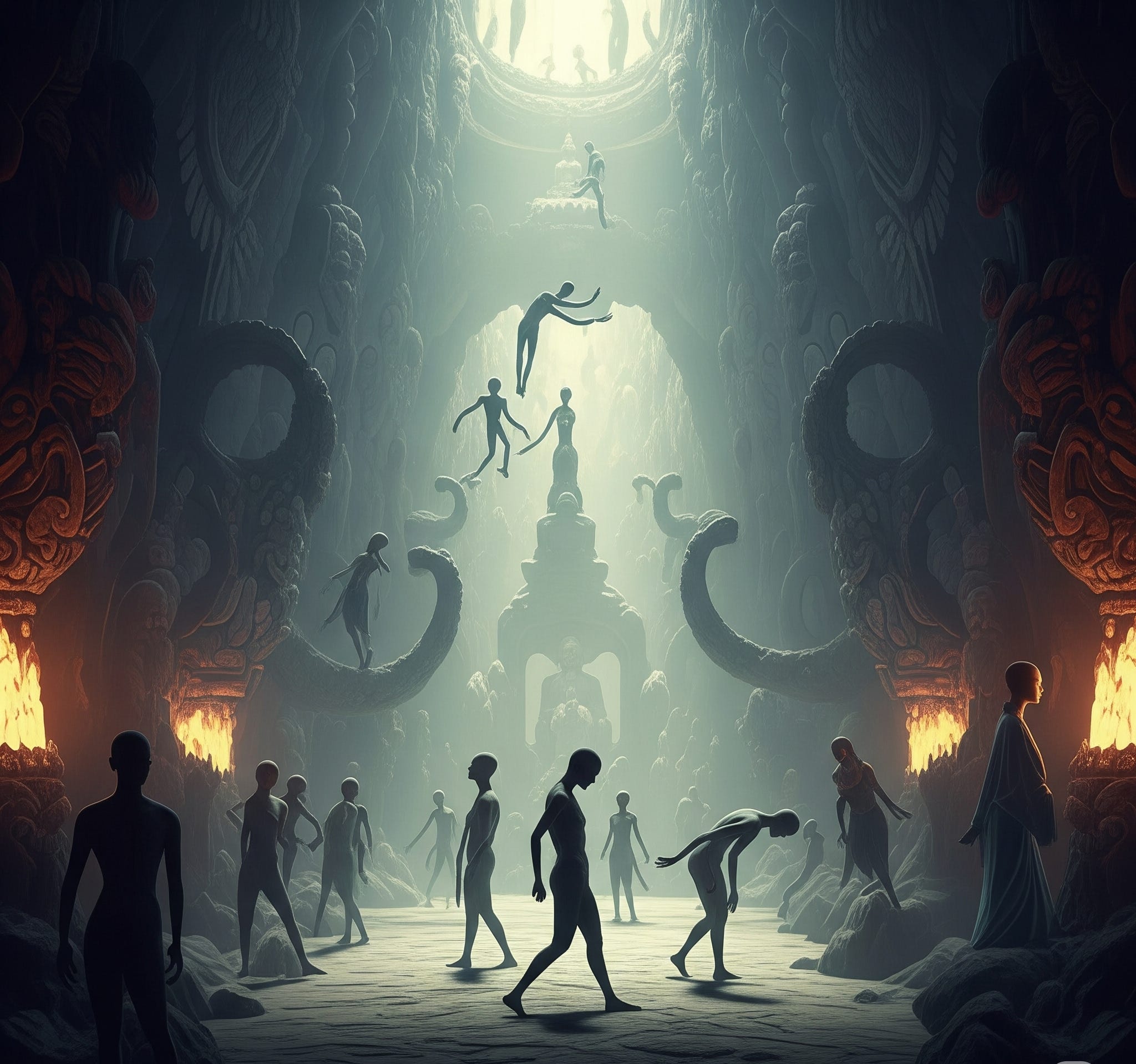
Bardo…1. noun: an intermediate, liminal state between death and rebirth;
2. In Tibetan Buddhism, the state between two lives on earth;
3. A metaphor for the shared but unacknowledged condition of American society in 2025—life in suspension, always on the way, with mutual grief never reconciled or consoled.
Introduction (first post in a series)
How to understand this moment in American life—are we not all trying to do this? But I don’t mean understand it in political or sociological terms. And not just this administration.
An exhausting number of explanations have been offered, some of them reasonable and some probably valid.
But they don’t go deep enough. That’s because this time in our history increasingly feels like a shared nightmare. Or like living in a simulation created by invisible technofeudalists.
But the latter explanation implies that our condition is something new, something enabled by latest wave of Death Star platforms.
Making technocracy the sole cause of this shared fever dream only demonstrates our cultural and historical amnesia. It leaves us helpless to understand how we actually arrived at this moment, somewhere in the middle of a mysterious transition to…somewhere else.
In the thought experiment which follows, I’m suggesting that our history of buried suffering has created a shared spiritual crisis of a particular kind.
We find ourselves between past and future, as the invaluable Hannah Arendt described matters more than a half century ago. She was speaking of our intellectual disorientation, given the loss of traditions as well as any shared sense of the world.
Or might we see American society as undergoing some kind of collective rite of passage? This term, taken from Arnold van Gennep’s 1909 book, was coined to describe an individual’s passage from one status to another (as in initiation ceremonies) and from one life situation to another (graduation, marriage), as well as the passage of time (birthdays, the New Year).
Can an entire culture undergo a rite of passage? Is some other kind of transition going on? Perhaps a deep societal process has been underway, one which we rarely allow to surface because we can scarcely bear to confront it.
I’m proposing here that our dreamlike state can better be understood as time in a bardo, using metaphorically the Buddhist concept of a transitional state between between death and rebirth.
I see American society suspended unknowingly inside a Bardo of Grief. Which is to say: as a society today, we’re perpetually, agonizingly stuck, spiritually and existentially.
Tibetan Buddhism recognizes three bardos experienced in life—the bardo of birth/life, the bardo of dreaming and the bardo of meditation—and three experienced during the process of dying—the bardo of the moment of death, the bardo of reality/luminosity, and the bardo of becoming/rebirth.
But suppose grief from a significant loss can also take us—indeed, our entire society—into a bardo realm.
For our investigations here, I want to sketch out the nature of the bardo of grief in order to suggest its resonance with our public and private lives today. So a few words about why I’m exploring this metaphorical approach.
֍First, our American malady—which is more than a malaise--goes beyond economics or politics: again, and like many observers, I believe it is fundamentally spiritual in nature, as I suggested above.
But we need a different spiritual lens at this moment in order to see more deeply. I find that the American encounter with Vietnam and its culture of Buddhism, beginning well over a half-century ago, has profound significance today. We, the sick giant, are very much in need of the healing wisdom and spiritual resources of this small country.
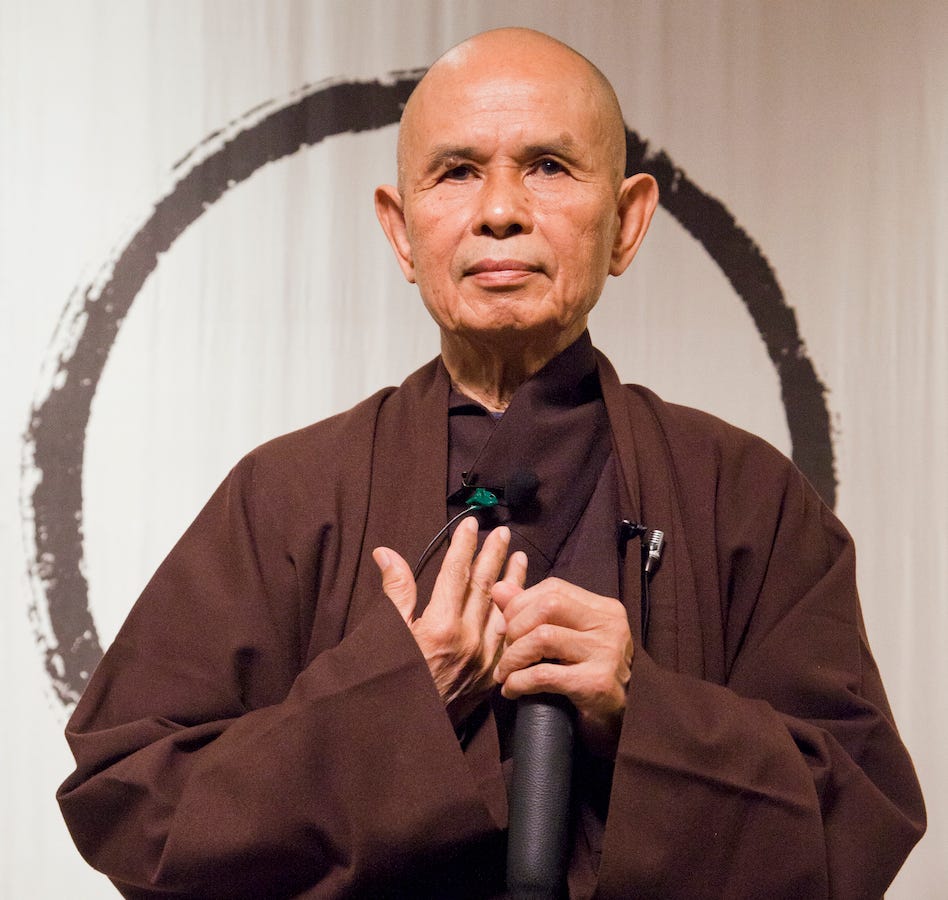
Thus the teachings and witness of Buddhist monk Thich Nhat Hanh (here’s a discussion of his work relevant to this post) will be important in this series.
Grief, as Mark Robert Frank writes, is a reaction to the precipitous, uncontrolled, and undesirable loss of self. That’s quite different from the controlled and desirable loss of self that takes place within the context of spiritual practice, or the uncontrolled but desirable loss of self in the context of falling in love.
In several forms of Buddhism, the bardo realm is the in-between, transitional, liminal state between death and rebirth. Whatever remains of the self goes out in search of its next rebirth. In this state, the deceased may experience a phase of intense grief, especially if they were not prepared for death—i.e., they have not learned to die, as philosophers once described the motive for their inquiries.
In the bardo realm, the deceased gradually realize they are dead and no longer among their loved ones. In scenes perhaps reminiscent of Dante’s great poem of other worlds, they may see and hear their loved ones and yet be invisible to them—a cause of great anguish. According to Buddhist teachings, the deceased experience a range of emotions related to separation, including sadness, loneliness, and a sense of alienation.
The traditional Buddhist texts describing these emotions also refer to visions of both peaceful and wrathful deities, depending on how we have used our lives (which is reflected in our karma) before death.
On the individual level, understanding the bardo of grief is beneficial in two main ways. First, it shows us mourners how to help the deceased navigate this transition and achieve a better rebirth. Second—and especially for our purposes—it helps the living cope with the loss of a loved one.
As many readers here will know, a central text for understanding this tradition is the Tibetan Book of the Dead or the Bardo Thodol in Tibetan.
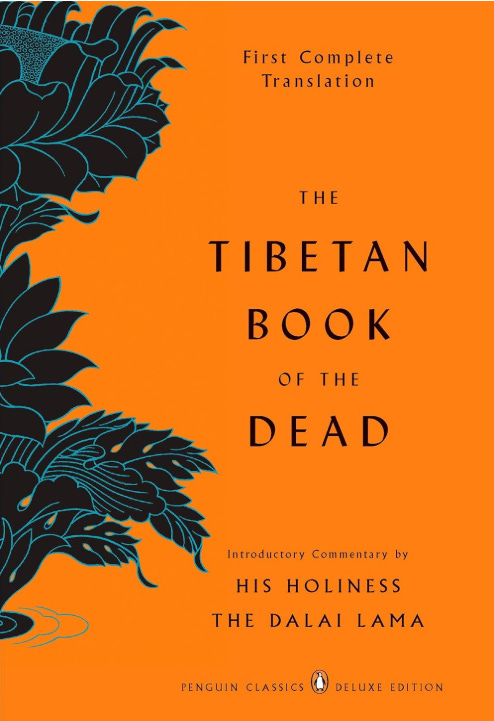
These teachings include a number of ritual practices which mourners can undertake in order to lead the departed toward a fortunate rebirth. And to help them avoid getting caught up in mental delusions that would lead one to the hell realm or the condition of becoming a “hungry ghost”. The latter concept is a very suggestive one for citizens of a society dominated by consumerism.
The Hungry Ghost Festival is celebrated by Buddhists and Taoists in numerous Asian countries. On Ghost Day, the spirits of deceased ancestors come out from the hell realm in order to visit the living and be venerated or appeased. Some are spirits without descendants who thus have received no tributes from the living after death, leaving them in a desperately hungry, thirsty and restless state.
Ritualistic food offerings are prepared at tables with empty seats for the spirits. Relatives burn special “hell banknotes” (non-legal tender especially printed for this purpose) and other forms of joss or incense paper in the shape of houses or cars in order to please the ghosts and give them support in the other world.

The hungry ghosts being appeased are those spirits who are driven by intense emotional and physical needs in an animalistic way. They are often depicted in Buddhist art with big bellies and needle-thin necks to signify their suffering. One category of these nightmarish figures—the ghosts of losses—are always covetous, searching out human filth to eat at night. In life, they sought enjoyment in both clean and unclean things and were thus reborn in this condition.
Another category: the ghosts of flaming mouths, with bodies like a palmyra tree. Their condition shows the karmic results of stinginess.
If I am not stretching a metaphor absurdly far here, I can imagine our society as crowded with hungry ghosts, endlessly craving, always consuming. And like the newly dead in Tibetan Buddhism, some of us Americans suffer torments from karmically generated hallucinations of figures who appear to threaten us.
But no rebirth into a happier state is coming in our case. At least not until we confront our lack of public occasions for lament like the three “Great Chanting Ceremonies” undertaken for the war dead by Thich Nhat Hanh in 2007 in his native Vietnam. (I will describe these in a later post.)
In his impact on American spirituality, I think of Nhat Hanh as a terton, the Tibetan Buddhist term for a “a discover or revealer of (dharma) treasures.” The treasures are scriptures (called termas) that have been deliberately concealed and discovered at appropriate times by realized masters through their enlightened powers.
Some of these tantric scriptures are concealed in rocks, lakes, and temples: they are called Earth Termas. Others appear as mental awakenings and are called Mind Termas. We might consider Nhat Hanh’s teachings as falling into the latter category.
֍But let’s begin with some grounding in terms of our situation in the U.S. What follows in this series are sketches drawn from life—or more specifically, our history over the last half-century--and my attempt to think out loud about them, drawing on more than one wisdom tradition.
The common thread throughout is my strong suspicion that almost all of us in American society today share a particular kind of unrecognized condition: the existence of “unprocessed” or buried grief.
Thus I’m not reflecting here on personal grief or its trauma discourse: instead I want to confront our unexamined legacy of communal grief.
Like a pool of contamination awaiting discovery beneath a plot of land, I think of our buried grief as a calamity which must be “remediated.” Remediation would mean, in the jargon, closure, especially the communal closure I want to examine here—the kind that comes from public rituals of lament.
In such rituals, it is the community that mourns, that imposes the mourning upon itself, as we have learned from philosopher Byung Chul Han in his Loss of Rituals. Which leads us to ask: where is our community today? Where and how might it offer and conduct a ritual of mourning?
The condition I’m exploring here is more than a lack of closure. And more than simply our American culture’s well-known avoidance of death and dying.
Hoping not to invoke the malign deities, let’s take up seven historical sources of destabilizing grief, most of which have enfolded over decades, all of them based in common experiences, all of them still quietly contaminating our shared life:
The grief of the COVID-19 pandemic, with its 1.5 million dead in America (and over 7 million worldwide), when a profound human impulse—to mourn family members in public funeral ceremonies—was often put aside by something very like a state of emergency;
The grief of the over 700,000 dead from the HIV/AIDS epidemic which started in 1981;
The grief of the over 176,000 “deaths of despair” between 1999 and 2021 from addiction, suicide and alcohol, due partly to the decline in living standards and social status for a significant part of the American middle class;
Partly foreshadowing the latter, the slow grief of losing our entire rural culture, some 4 million family farms in this country between 1940 and 2012, representing perhaps 25 million people leaving the land, thus removing from it and themselves, as Wendell Berry reminds us, their “love, care, skill and work”;
What’s been called America’s racial karma—our 246 years of legalized chattel slavery, followed by a century or apartheid, as well as the destruction of our Native peoples and their cultures;
The grief of those affected by the toll of America’s perpetual wars over the last two decades (over 7,000 deaths in Iraq and Afghanistan), as well as the annual average of 250 self-inflicted deaths by U.S. service members;
Our shared grief over our burning planet and its wildfires, 500-year storms, dying oceans, lost species, heat waves, desertification, sea rise, displaced communities, climate refugees, and what may become a sixth mass extinction.
Our collective reaction to these losses resembles the often-noted silence and erasure around the flu epidemic of 1919 which killed over 50 million people worldwide. In the U.S., none of these shared catastrophes of the last half-century—all of them enormous in scope--have led us to mount occasions of public mourning on a national scale.
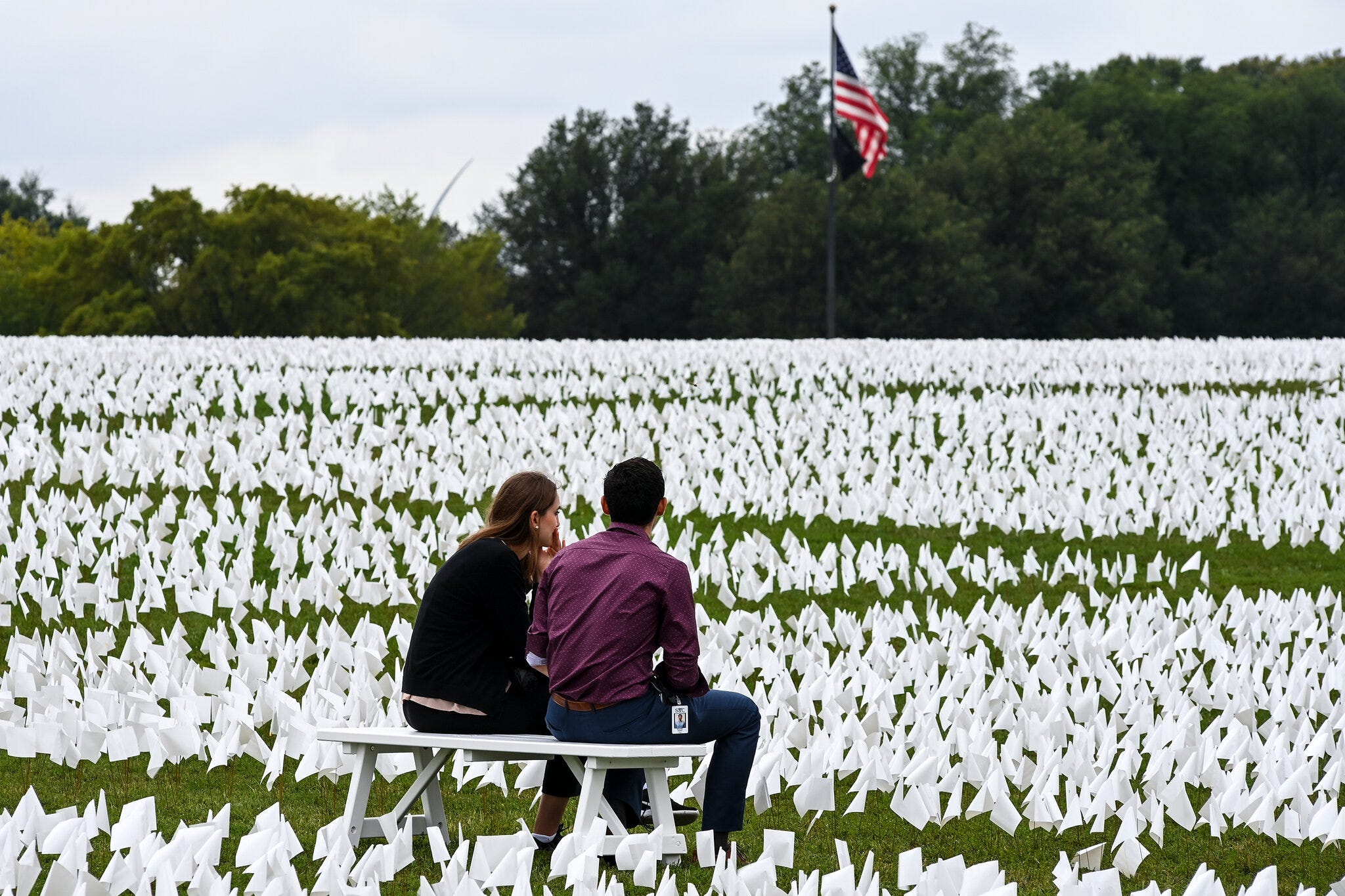
What then does it mean to live in a society which has allowed its social practices to degrade into merely instrumental and economic relations?
Simply that we now lack the grief communities and the rituals of lament which could bring us social healing in the form of forgiveness and reconciliation.
֎ Grief as a spiritual enzymeOne of the most insightful writers on these topics is Martin Prechtel whose work teaches that grief is not simply disappointment: it is as natural as singing or dreaming or eating.
Nor is grief simply sorrow—in fact it refuses to remain in sorrow. It is an obligation to the life we have each been awarded—an obligation to make more life. It should not be a mere preference. “Choosing not to have grief,” he writes, “burdens someone else and makes the world a sick place.”
And this: “Only nations capable of the true art of grief, grieving their mistakes and the deeply felt losses they endured, can say they are not pools of economic stagnation dressed up in the spoils of ungrieved wars disguised as good business.”
Another of the most powerful insights in Prechtel’s writing is his connection of grief with praise. Grief is “the best friend of Praise because Praise is a grandiose griever. Without grief and praise, life is only hate and mediocrity.”
In essence, if we do not grieve what we miss, we are not praising what we love—“we are ourselves in some way dead.”
Echoing philosopher Byung Chul Han, Prechtel argues that living communities are necessary for people to grieve in a real way. “Grief, even for an individual’s loss, is a thing for which a lot of people are necessary.”
Tragically we have gradually lost the culture in which we could grieve together as a society. Worse, we defer the grief of a previous generation onto the next generation, creating a dangerous and inhuman condition. All the people and places lost, Prechtel suggests, “are buried in a shallow mental mass grave of temporary amnesia in the collective mind.”
What we lack is the process by which grief, defined as a “spiritual enzyme”, metabolizes our losses. If we do not allow this to occur in some communal fashion, the grief almost always goes to a form of accusatory violence and the destruction of our common life. Thus the adoption of revenge works as a way of freezing grief and, in Prechtel’s phrase, “making a shrine to someone’s losses.”
Reading Prechtel, a terrible realization gradually comes over us: that we are all living on top of a buried continent of unprocessed communal grief.
No matter how well we may be dissolving our personal sufferings with the enzymes of grief, we have chosen collectively—and over generations—to live inside a history of great losses, human and natural.
Grieving, he explains, is not a form of depression—which is a condition that comes from not being able to grieve, in which we convert our losses, our “frozen sorrow”, into violence. But what if grief is not sorrow and refuses to remain in sorrow?
Might Prechtel be correct that we possess an ancient way to revive an entire culture, if we truly and freely grieve? Might the practice of grief—itself a sacred art—be the foundation of all our work toward peace and reconciliation?
I welcome your comments and I’ll be posting another piece in this series soon.
Elias, this is a remarkable - and remarkably original - essay. I have lately become aware in my own spirit of a kind of sullen ennui. I hadn't connected it to grief, but it seems to fit very neatly into the space between bargaining and depression, with lingering anger and even denial. To your list of seven historical sources of destabilizing grief, I would add the ongoing collapse of the American Republic into authoritarianism. That is a grief every bit as present as watching a loved one's death agonies.
Thank you for your thoughtful analysis. Your framing of American society as suspended in a bardo of unprocessed grief resonates deeply. I appreciate your insight that grief could function as a "spiritual enzyme" to metabolize loss communally, not just individually.
Your work here brings to my mind Vanessa Machado de Oliveira Andreotti's "Hospicing Modernity," which explores similar terrain in a slightly different way. Where you emphasize the need for grief rituals and ceremonies to heal American culture, Andreotti explores how "Modernity/Coloniality" as a global system (the words for her have specific meaning beyond the typical) is dying and requires "hospicing": sitting with the demise without guarantees of what comes next. She also draws on Indigenous wisdom traditions to critique modernity's denial of death and limits.
The two frameworks feel complementary: your bardo work offers the emotional and spiritual practices we need, while Andreotti provides systemic analysis of why Western culture lost grief capacity in the first place. In both, we can't think our way out; we must feel the losses, and learn to accept uncertainty.