


[Part One of this series can be found here; Part Two is here and Part Three here.]
I witnessed the workings of the pride economy—and its slow-motion collapse—when I made a temporary move east across northern Indiana to South Bend in 2020. My motive was to collaborate with a project related to resisting gentrification. The idea was to increase the number of homeowners who could be coached into becoming small developers—incremental development being the term for this approach.
Unfortunately, as I was unpacking in South Bend, Covid-19 also arrived--which hampered the community work I had hoped to do. But I spent two enjoyable years getting to know the city in the afterglow of former Mayor Pete Buttigieg’s ascent to Secretary of Transportation in the new Biden administration.
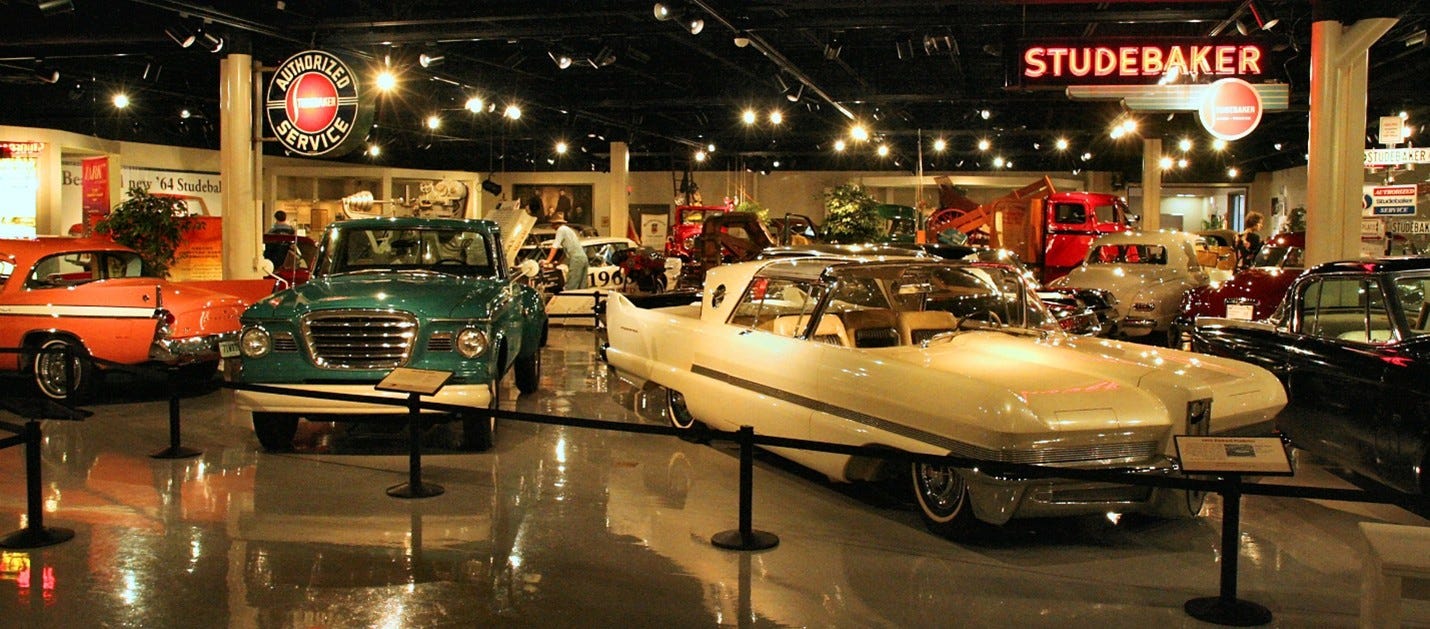
The pride economy described by Arlie Hochshild was plainly still operative in South Bend in the ever-present ghost of the Studebaker automobile company. This hometown enterprise dominated the civic spirit of South Bend for over a century, employing thousands of workers—over 16,000 at one point in 1956 in a city of only 100,000—with well-paid, unionized jobs.
The date many older citizens remember, however, is December 20, 1963, only a few weeks after the assassination of President John Kennedy. That’s the day the 111-year old South Bend Studebaker plant closed after a decade of gradual decline. Some 7,000 people lost their jobs.
One weekend, I visited the Studebaker National Museum, an marvelous collection of historic vehicles, including several concept cars which gave me twinges of teenage glee.
The museum’s parking lot was taken over that morning by Studebaker owners, several dozen local enthusiasts who parked their mint-condition Avantis, Hawks, and Starliners, in lemon yellow, lime green, or a special pink-white-gray combination and stood around talking about the glory days.
At one point I was invited to an event at the 1884 Studebaker mansion, now a swanky restaurant. And I often took walks past the Studebaker Electric Fountain in Leeper Park. Some millennial friends organized a story-telling event in the former Studebaker factory called “The Studebaker Talks.” Today there’s still the Studebaker School, the Studebaker Golf Course, Studebaker Plaza, and the Studebaker “living tree” sign—more than 8,000 pine trees planted in 1938 to spell out the company name in huge letters visible to an airplane overhead.
In 2012, the year of his first mayoral run, Mayor Pete gave a very good local TED talk invoking the spirit of innovation the world once associated with the city of South Bend. (Equally or more important, I discovered, was South Bend’s hidden resource in its sizable cohort of talented millennials—Pete’s people—who are devoted to their place.)
For every city like South Bend attempting—with some success—to overcome its post-industrial status, the state of Indiana has perhaps a dozen other places which are sliding into the status known as “ghost towns”, a label already applied to some 41 in all by one estimate. Their decline is not entirely from the last half century’s industrial restructuring and offshoring. Some began after the state’s natural gas boom of the 1880s began to play out in the 1910s.
Driving across Indiana north to south on the smaller state roads, you have the same experience today as a driver crossing, say, Texas, Kansas, Louisisana, or Oklahoma. You might call it a “Twilight Zone effect.”
You enter a little town whose skyline includes an historic courthouse with a pleasant-looking park nearby. Then, as you proceed down the town’s main street, you have the grim realization that the storefronts are all empty, with maybe a tattoo parlor and a bar remaining. Almost no one is around.
֍
My experience with sacrifice zones and places of abandonment is not limited to urban areas. For a few years I was a founding board member of the Northwest Indiana Food Council, a non-profit focused on small farms, healthy food systems, and an annual tour we called the Farm Hop.
The Farm Hop was a daylong bus ride around the Region, with stops to visit a mix of operations, including urban farms in the city of Gary, a peace garden, an aquaponics farm, and a 13-acre specialty farm growing 130 varieties of vegetables, herbs and flowers.
The Hop also offered a visit at a 1,160 acre place operated by one (!) person—a former Wall Street professional with farming roots. Whereas, as he told us, his family’s farm back in Wisconsin required numerous hands working on small tracts of land, he is able to handle his commercial corn and soybean crops with only one occasional hand. That’s partly because, as we witnessed, he owns several enormous pieces of farm equipment, including a huge digitally-outfitted tractor.
One question which our Farm Hop participants might well have asked is: what percentage of the food Hoosiers eat do they actually produce themselves? That number turns out to be less than 10%, in fact.
Years ago, the agricultural economy in Indiana and the U.S. generally was quite different. The USDA records for 1945 shows 176,000 farms operating in Indiana, with an average size of about 100 acres. Today the numbers are roughly 45,000 “family farms”, averaging almost 300 acres.
In 1940, U.S. farms numbered around 6 million, each averaging about 175 acres. Today, the long-term decline continues, with the current number being about 1.8 million farms, averaging 441 acres with the median size at 72 acres.
Those numbers disguise what agrarian philosopher and farmer Wendell Berry has described as another Great Migration—the 25 million rural people who left the farming economy between 1940 and 1967, i.e., in less than half a lifetime, as he notes.
For half a century and more, Berry has been our most perceptive public philosopher on many topics but especially in his lament for the destruction of what was once “an intact, authentic, functioning rural culture.”
To understand better why our rural areas have also become sacrifice zones, Berry suggests “Farmers and the land have been sacrificed to the need for cheap food, just as the miners and the land of Appalachian coalfields have been sacrificed to the need for cheap energy.”
He continues, powerfully: “As a result we live in and from an abandoned, unloved, toxic, eroded and degraded country that most of our people have forgotten or never knew.”
Our emergency, as he explains in his The Need to Be Whole: Patriotism and the History of Prejudice, “is that the both the land and the people are unhealthy.” Which also means: they are unhealed.
֍
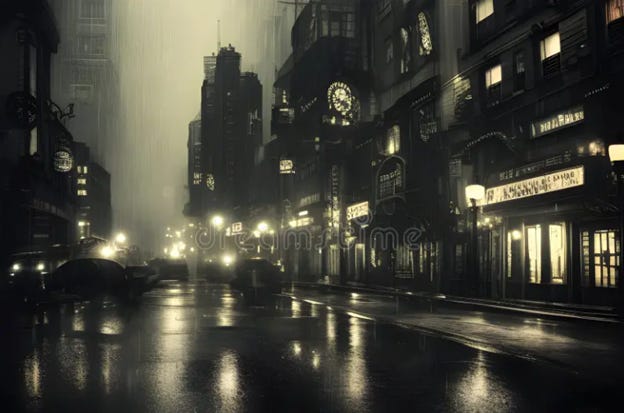
In old black and white photos from the 1940s and 1950s, the streetscapes of New York, Chicago, San Francisco inevitably look like noir film sets.
Looking more closely, there’s something else: the modest scale and the gritty, unfinished appearance of these places, a far cry from the glossy “perfume bottle” skylines of today.
As photos from these years also document, cities across the U.S. once contained many “urban villages”, lower-income but vibrant, functioning neighborhoods with the kind of social connectivity whose loss in terms of social cohesion we lament today.
This cultural density is where we got urban flowerings such as the Harlem Renaissance, Chicago’s Bronzeville society, San Francisco’s Fillmore neighborhood, and the New Orleans-like culture of Pittsburgh’s historic Hill District.
It was segregation which made the ghetto, as social psychiatrist Mindy Fullilove pointed out, which in turn made “the archipelago state and its local representative, the neighborhood.” These island-like communities had a shared common life which maintained the practice of older customs, especially the kinds of mutualism and cooperation needed to survive under enforced apartheid.
White citizens did not know much about these enclaves of color but assumed they were slums—meaning, unsafe, unhygienic, and detrimental to nearby real estate values. Some them still had outhouses. And, perhaps worst of all, they were located too near to downtown, thus giving out-of-town visitors a bad impression.
But in the years immediately following the Second World War, the pressure for housing and the hunger for civic “progress”—in the shape of a futuristic glass-and-steel skyline--was growing.
Thus the passing of the 1949 Urban Renewal Act was an effort to clear “slum” housing for private developers in order to extend the central business districts—Manhattan’s Lincoln Center being only one notable example. Similarly, as Fullilove documents, Roanoke built a new post office, civic center and a Ford dealership in the northeast corner of the city on land which had for decades been a strong and close-knit Black community.
Altogether, over the next several decades, some 2,500 urban renewal projects in 993 U.S. cities were undertaken, of which 1,600 were in Black neighborhoods.
The result was the displacement of nearly one million people, 66% of whom were Black, along with the loss of their churches, businesses, and social spaces.
The multiple impacts of this enormous exercise in social engineering may not have been apparent to city officials, planners and developers, almost all of whom were in lockstep agreement about the “costs of progress.” Certainly Native American communities had historic knowledge of mass removals from decades ago.
As we now know, urban renewal had many indirect costs: destruction of local businesses and livelihoods, loss of social organizations, and psychological trauma—what Fullilove called the loss of the “life world.” The title of her 2004 book on this tragic history is Root Shock, a term she coined to describe the traumatic psychological effects experienced by whole neighborhoods of people who are suddenly uprooted.
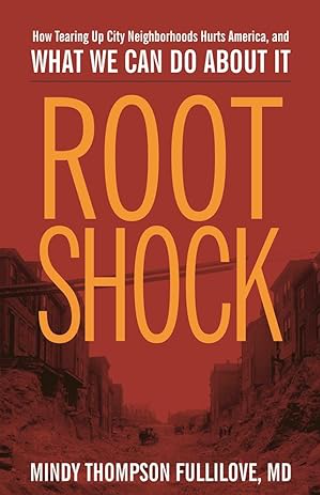
Fullilove unpacked the term root shock by listing three ways urban renewal policies affected the general wellbeing of displaced community members.
First, root shock generates stress, trauma, and prolonged grief among those who whose social bonds and sense of stability are radically shaken. It destroys the working models of the world that had existed for generations inside people’s heads.
Second, it is an indirect cause of illness caused by sub-standard living conditions often found in the new places (i.e., public housing projects) to which people were relocated. In urbanist Jane Jacobs’ distinction (Fullilove was a student and mentee of Jacobs), one kind of area may operate as a perpetual slum—i.e., people are continually leaving it—while another could be called “unslumming—i.e., people are continually staying.
And third, it was a forced outlay of resources on resettlement instead of maintaining wellbeing in place.
Altogether, the process could be described as having three sets of costs for neighborhood residents: financial, social and political. Not all these impacts were immediately obvious.
For example, local jazz clubs were once a staple of cultural life in numerous U.S. cities. One answer to the perennial question of “what happened to jazz” is simply that its national web of little clubs was almost entirely bulldozed out of existence in the 1950s and 1960s. We could say the same for most of the small restaurants and shops that once gave a place a distinctive character.
The striking nature of Fullilove’s research for our purposes is that it focuses on community grief from dispossession, and a form of spatial injustice we have come to recognize very belatedly.
Fullilove’s teacher and friend, Jane Jacobs, was a deep critic of modern urban development, notably the kind practiced by New York’s Robert Moses in the 1960s. In these matters, Jacobs sometimes invoked the “sparrow principle”, as she called it. Not a sparrow should fall in executing planning schemes—i.e., no one in the neighborhood should be hurt, nothing done at anyone’s expense. No one experiencing a shock down to the roots. We might guess that such an idealistic standard has almost certainly never been applied—anywhere.
While Black communities suffered most from root shock, the phenomenon was never limited to any sincle racial group. To take a famous example, what was the psychic price paid in 1957 by white neighbors of Brooklyn’s Ebbets Field when, after 44 years in the same ballpark, Dodgers owner Walter O’Malley moved the team to Los Angeles? Beyond the demolition of the stadium to build apartments, what else changed for Brooklyn in terms of its civic spirit?
If the latter example of an abandoned sports stadium seems merely sentimental, consider the impact in recent decades of the Catholic Church’s closing hundreds of local parish churches, many of them sites of generations of family history—christenings, weddings, funerals—for large numbers of residents in the area.
Even for non-Catholics, it turns out, certain kinds of landmark spaces retain an aura of stability and authenticity which make them beloved essential pieces of the local fabric—like familiar friends. The calculus of progress simply cannot account for these things.
[To be continued.]
Well done, Elias. I spent a lot of time on a farm growing up and spent the last 10 years of my career working on food justice and food security, arranging financing or serving on boards. These are good stories. I also spent my whole career working in the Tenderloin neighborhood in San Francisco, and currently live on the hill between the Tenderloin and the Fillmore, one neighborhood which you mention in your piece, the other a type you alluded to, namely, poor, recent immigrants living in slum conditions close to downtown (and I have opinions on the best noodles and best chicken in both neighborhoods.)
This is THE STUFF of community development. Great to see you talking about it. Thanks!
Very well stated Elias. Would many of these communities simply completed their own life cycle and died a natural death, only to be replaced by whatever came next anyway? We'll never know. In any case, there were accelerants. Having lived through it and witnessed it, the disintegration of black communities in the aftermath of the MLK assassination cannot be overstated. I consider it the watershed event in our nation's urban history, at least in my lifetime. You can also point to mobility and large scale retailing. People get in cars and drive out of the neighborhood to buy stuff. That's a killer. Especially when you throw in plenty of free parking. But you touched on it by talking about Studebaker. Neighborhood roots grow deepest when they are mixed use. When entire sections are all residential or all commercial/industrial, vulnerabilities reveal themselves over time. BTW, the Avanti. Coolest car ever. All that I wanted when I was a kid.