


[Part One of this series can be found here; Part Two is here.]
I have not read Hillbilly Elegy, the 2016 memoir of Vice President J.D. Vance, whose successful escape from Appalachia and his troubled family put him on track to political fame and even the White House. Some reviewers wanted to take the book as an insider’s explanation of Red America, especially the Heartland and its forgotten-man culture of Trumpism.
From the reviews of Vance’s book, it does not sound like an elegy, certainly not a nostalgic reflection on lost folkways like the joys of mountain dulcimer music. It will not put anyone in mind of Wendell Berry’s writing about community and membership in Port Royal Kentucky. The reviewers suggest it reads more like the effort of a rising politico trying to establish his policy chops.
A better title might have been Hillbilly Makes Good, given the air of self-congratulation which seeps through the story of Vance’s ascent to Yale Law School and a Silicon Valley venture capital fund before being discovered by the Man of Destiny.
As a better title—and a better analysis of his own roots—I would have suggested Hillbilly Grief. A culture of unacknowledged grief lies behind the three generations of the Vance family described in the book, born out of living through, like millions of others in post-industrial America, several decades of economic devastation, cultural demonization, opioid overdoses, and deaths of despair.
To bolster my claim as a participant and witness in this history, let me insert here an autobiographical note.
With a population today of 13,000, my hometown of Henderson Texas is only slightly larger than when I grew up there in the 1950s. In some respects, it resembles Vance’s Jackson Kentucky, the place he calls home. (It also resembles the fictional Anarene Texas, site of Peter Bogdanovich’s 1971 filmThe Last Picture Show.)
Its location in East Texas, with Shreveport only an hour away, means the local culture in my hometown today was always more Southern than Texan. The poverty rate is 13% with an additional 33% of the population classified as ALICE (asset limited, income constrained, employed), which means almost half the town is not making it, economically speaking. That statistic has definitely changed since my childhood and not for the better.
Like Vance, I always knew growing up that I had to leave town. But it was once in better shape before the neoliberal economy of the 1980s began to take a toll on its main street and local families as well. So I’m familiar with Vance’s childhood world and its citizens. Whereas his early world was that of coal country, mine was oil country.
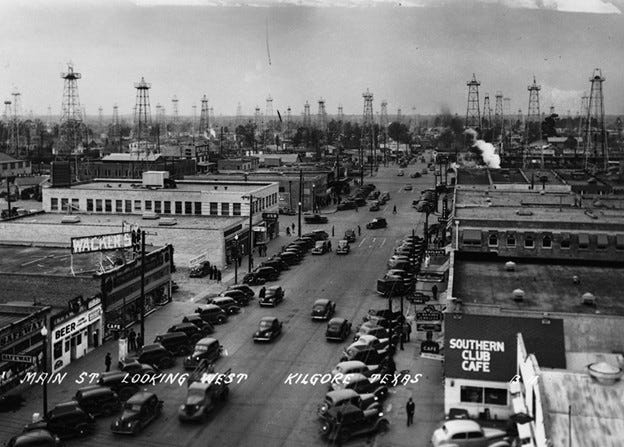
The arrival of the first gusher of the East Texas oil and gas field in 1930—some 140,000 acres across five counties with 30,000 historic and active oil wells—altered the psychology of an entire region. A red-dirt agricultural economy primarily based in cotton suddenly entered boom times and the mass delusion called “get rich quick.” Because that’s what oil could do for you while the going was good.
In my high school days, we played sports against the neighboring town of Kilgore, an epicenter of the oil field. At one time, its small downtown had more than 1,000 active wells, making it the densest oil development in the world.
As we rode the school bus to the Kilgore game, we would pass pumping rigs on what seemed like every other city block. Unless it’s a figment of my imagination, I think there was even one working drilling rig on the Kilgore High School football field. The players had to be careful not to run into the “rocking horse” in the end zone.
My father described the first years of the boom—his high school years in the 1930s—as truly a Wild West. His father was at work one afternoon in a downtown bank building when a gunshot rang out from an upstairs land office where some disgruntled party to an oil agreement decided to settle things on the spot. Because the local jail was relatively small and the number of lawbreakers so numerous, Dad explained, the local sheriff was reduced to tying arrested folk to trees until the police wagon could make the rounds of the county to pick them up.
Whatever reflections the people of East Texas might have had about the coming of oil, there was no thought that fossil fuels might be anything but a divine blessing. Nor was there anyone asking whether this freakish jolt of unearned prosperity and the mania it brought might in fact be a poisoned chalice. Karma waiting underground.
Over recent decades, the gradual depletion of the mammoth oil field—over 5.42 billion barrels have been produced from it—was not accompanied by any meaningful efforts to diversify the regional economy. Which is what allowed almost half the population of my hometown fall into the ALICE category.
While numerous small towns in East Texas have a dilapidated and depopulated look, the region is not the most egregious example of a sacrifice zone, if we extend that term to include the impact of economic devastation as well as that from industrial pollution.
A better candidate, one familiar to me from later personal history, is about an hour south of Chicago—the five counties of northwest Indiana known by locals simply as “the Region,” as bland a geographical nickname as you could find.
֍
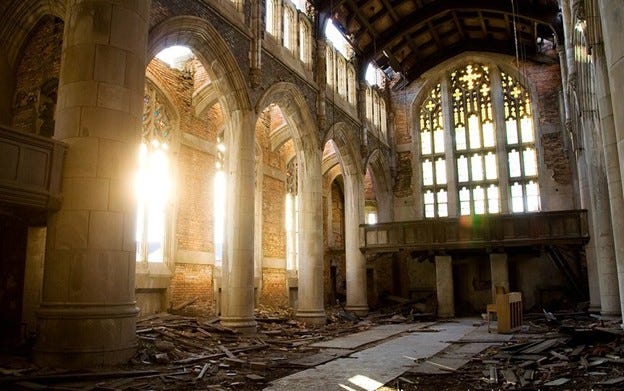
Soured dreamlands
The region of Northwest Indiana, as I discovered years ago, has a nickname: locals refer to it simply as “the Region”. No one has come up with anything more descriptive, less banal. If you live in the area, you’re a “region rat.”
The Region is an archipelago of a few middle-class towns not far from the shuttered steel mills, polluted industrial sites, and boarded-up storefronts of neighboring impoverished places like Gary, East Chicago, Hammond, and Michigan City. These are towns whose percentage of the population in poverty (officially defined as $16,000 annual income for a single person, $32,000 for a family of four) is around 30%. (The national rate currently is just over 11%.)
One of the Region’s happier islands is the leafy college town of Valparaiso, where I spent twenty years raising my daughters while trying to learn inhabitation, as the poet and ecologist Gary Snyder calls it. Snyder’s term refers to the process by which you come to deeply understand the place in which you live in all its dimensions—historical, environmental, geographic, and economic.
Around our little town, as I came to realize, lay a vast expanse of the Rustbelt or the “soured American dreamland”, as the urbanist James Howard Kunstler once put it acerbically after visiting the area two decades ago. Here’s a sample of his impressions:
“The storied steel mills of Gary are gone, and the numberless small shops and sheds that turned out useful widgets exist now, if at all, as ghostly brick and concrete shells along the stupendous grid of highways…Between the ghostly remnants of factories stood a score of small cities and neighborhoods where the immigrants settled five generations ago. A lot of it was foreclosed and shuttered. They were places of such stunning, relentless dreariness that you felt depressed just imagining how depressed the remaining denizens of these endless blocks of run-down shoebox houses must feel…Yet people were coming and going in their cars from the welfare ruins of East Chicago to the even more spectacular tatters of Gary, where the old front porches are disappearing into prairie grass and the 20th century retreats into the mists of mythology.”
My first impressions of the sacrifice zone known as Gary were drive-by glimpses from the interstate which passed just above the weedy backyards and along the empty-looking city center—a small Detroit, I kept thinking.
In 1993 it held the title of “’murder capital of the U.S.”, with an annual rate of 91 murders per 100,000. (The data for 2024 indicate the rate is down to about 70 murders per 100,000.)
Looking down from I-90, I felt the typical white person’s nervous shiver at the thought of the car breaking down somewhere along this stretch of road.
But in the early 2000s, I became involved in some community work in Gary, requiring me to attend meetings in City Hall. Turning off the expressway into the city steets of the downtown area—during the middle of the day, I should add—I had no particular sense of danger. Instead, what struck me was the terrible emptiness of the place.
In 1960, at the town’s heyday as a world center of steel production, the population was around 178,000 people. A litte more than forty years later, the city had only 80,000 residents left. Not even the city’s proximity to the southern beaches of Lake Michigan nor its status as the birthplace and childhood home of Michael Jackson have helped forestall the decline.
Sacrifice zones, with their associated disinvestment and unemployment, are known to bring in their wake deaths of despair, a term referring to lower life expectancy among middle-aged men due to a triple phenomenon of opoid addiction, suicide and alcohol abuse. Originally associated more with white Americans, these deaths have been increasing in Black and Native American populations since 2015, finally surpassing rates for white Americans in 2022.
A 2016 Federal Reserve Bank of Boston study compared the life expectancies of the poorest men in two cities: New York City and Gary Indiana. They found the lifespans of the Gary residents was five years less than that of the New York City group, suggesting that income disparities do not tell the whole story: geographical disparities are real and have a measurable impact. Your ZIP code definitely affects your fate.
These kinds of deaths went mostly unnoticed and unremarked until the 2020 publication of Deaths of Despair and the Future of Capitalism, by Anne Case and Angus Deaton.
A few years before the book appeared, it was an incident in our town involving a family member further that awakened me to my own community’s condition.
֍
Collapse of the pride economyAbout midnight one evening in 2017, I got a call from a police officer of our town. He informed me that our middle daughter, aged 18, and a girlfriend of hers had been picked up for possession of marijuana (still illegal in Indiana today!) and underage drinking. They were being held in the county jail until the parents could come by and pay a fine before taking them home.
I drove down, paid a few hundred dollars through the convenient bail kiosk, and then sat waiting in the lobby until my sheepish daughter appeared an hour or so later. It was all a bit comic, although I was worried about this misstep showing up in her college application efforts. In the weeks following, I located a local attorney who specialized in expunging this kind of court record who, in exchange for that service, expunged a few hundred more dollars from my bank account.
Somehow this small event gave me a window into my own community and its unseen life of despair.
The week following my daughter’s arrest, I was browsing through email and glanced at the local newspaper’s weekly newsletter. Among its regular sections was a photo gallery of people recently booked into the county jail, all of them wearing an orange jump suit. Staring back among the faces was one of my slightly dazed looking daughter.
After the shock of seeing her in this setting, I felt compelled to look closely at the faces of the other jail residents—fellow citizens of my town—as well as noting what they had done to get there.
It was a mix of ethnicities and ages, with about as many women as men. A young white guy with wild hair, smiling broadly. Next to him, an older Hispanic woman with a look of intense shame. His crime was creating a public nuisance (urination), hers was forging checks. I reviewed galleries from earlier weeks, just to get a further sense for these faces and their offenses. Rarely had anyone in this little Indiana town committed a serious crime. Quite a few were cases of DUI, along with several opioid dealers and domestic battery perpetrators. Almost none looked like “criminal types”: they looked like people struggling, in pain.
I imagined them staring back at me to say: See how I’m forced to live, the things I do out of fear or desperation. I can’t get a decent job, I don’t know anyone who is willing to help me get my life back on track. One false step and here I am, my pain on display in the gallery.
These are citizens of a state which at one time could be purplish: it once produced Evan Bayh, Birch Bayh, Richard Lugar, and Vance Hartke, to say nothing of Eugene V. Debs. It is now reliably red, voting for Donald Trump three elections in a row.
It is also one of the places where the effects of globalization landed in the form of offshoring, automation, and union decline. The losses inflicted on families—including their shame and loss of pride--over decades have been documented in numerous places, perhaps most notably by Arlie Russell Hochschild. Her Strangers in Their Own Land (2016) and Stolen Pride (2024), both based on extensive conversations with Red State citizens (in Louisiana and Kentucky), revealed the workings of an unseen “pride economy” alongside the material one, an amalgam of anger and mourning.
Well before the collapse of the pride economy—mostly felt by the white working class—there was another planned disaster: the urban renewal policies in the 1960s in communities of color.
Their legacy is called “root shock”, the ripping out of generations of community connection.
We’ll take up that story next time.
Your mix of research and personal narrative reminds me of James Agee's Let Us Now Praise Famous Men, with Agee's 1930s sharecroppers here replaced by citizens that remain in today's sacrifice zones.
The recent, almost after-the-fact dates of many of the books you cite suggest the West's perennial tendency to ignore those who for decades ignore politics and then enter it sometimes to overthrow the system. I'm rereading Hannah Arendt's The Origins of Totalitarianism, in which she claims the masses' sudden appearance in national politics exposed "that democratic government had rested as much on the silent approbation and tolerance of the indifferent and inarticulate sections of the people as on the articulate and visible institutions and organizations of the country." Finding ways to acknowledge and grieve and repent as a nation sure beats an increasing authoritarianism.
I never would have grouped the unresolved grief of those who lived through the collapse of the pride economy with those who lived through the displacement of America's urban renewal politics, but it makes perfect sense. I look forward to the next installment of this series.