


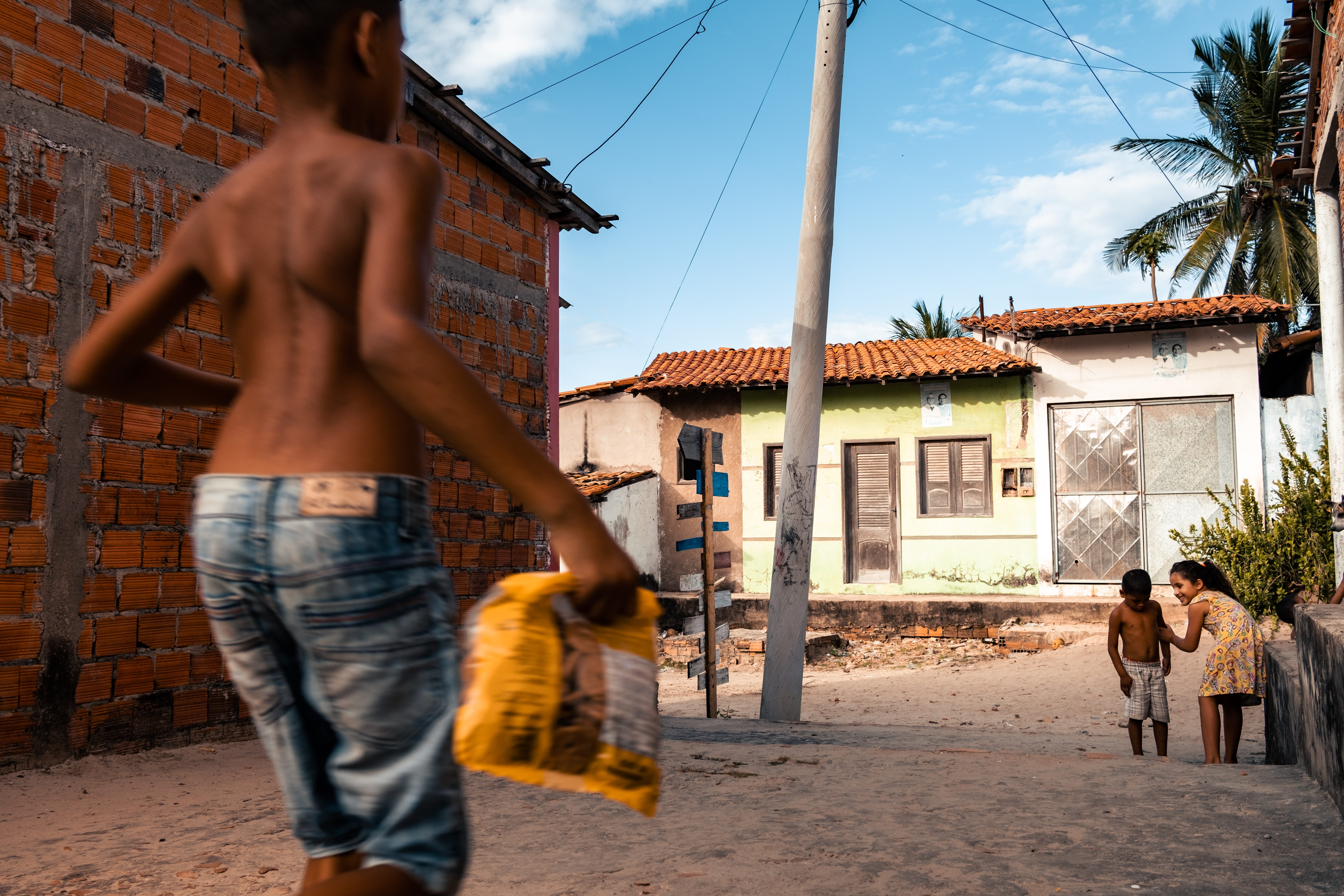
“Dare to bet on love given and received freely. Go to the peripheries.” — Pope Francis
By the peripheries, I’m pretty sure the Pope means not just the global South but also places in our own towns and cities — the homeless encampments, for example. Places where we encounter the poor.
The fact is, we need the poor — our liberation is caught up with theirs. We Catholics especially need to be evangelized by the poor. We need to have our hearts broken into humility.
And then we can have friendship with the poor and learn from their wisdom about structural violence and the gratuity of God.
More than that: we need to learn how to embrace a certain kind of evangelical poverty, in solidarity with the simpler, much more sustainable lifestyles of our fellow Christians in the global South. And soon.
This newsletter — which I’ll aim to make a weekly salvo— is an attempt not only to understand but to embrace joyfully this tectonic shift in world Christianity, now that two-thirds of all Christians live in Africa, Asia or Latin America. More than that, I will be writing about what it means to join the Pluriverse.
To begin with, here’s a little question we might ponder:
Instead of putting their national or cultural identities first, why aren’t Christians worldwide joined in ecclesial solidarity, as Michael Budde urged in a powerful essay several years ago? Who was killing whom in Northern Ireland in the decades of the Troubles? Or Rwanda in the civil war of 1994? Or today in Ukraine? We know Christians were (and still are) killing Christians, as they have done for centuries.
Within Catholicism, some are in a hopeful mood about the possible reconciliation which Pope Francis’ just-concluded Synod on Synodality might achieve.
I admit: I had no idea where the Synod was going, did you? (My theologian friend Matthew Shadle has some astute thoughts.)
While we’re waiting to see what impact it makes, we should probably remember what Thomas Merton advised anti-war priest Daniel Berrigan many years ago:
“Do not be discouraged. The Holy Spirit is not asleep.”
And really, if you’ll permit a Bob Dylan reference, you don’t need a weatherman to know which way the wind is blowing.
For quite some time, it has been blowing from the global South. (Ever noticed the lovely pun in the name Buenos Aires, Pope F’s homebase? His papacy, while imperfect, is part of the “good winds” now blowing.)
What this means and why it’s such a hope-filled new phase for the authentic life of the Church — and global Christianity in general — is part of what I want to unpack in coming issues of Street Catholic. (If you are wondering what the heck I mean by the latter term, my attempt to explain it can be found here.)
What a shame that for certain MAGA-minded U.S. Catholics and even some of their bishops, we North Americans are still the center of the world, still “exceptional” — in our privilege, at least, if not also in our growing ethnonationalism.
As probably dozens of notable Catholics remarked long ago, you have to suffer as much from the Church as for it. Noted theologian Romano Guardini (one of Pope Francis’ teachers) once even equated the institutional Church with the cross itself.
In a webinar conversation several months ago, my friend, theologian MT Davila, spoke of the sad “lack of prophecy” in most of our U.S. Catholic bishops as they continue to fail us in their role of being prophetic teachers. By contrast, can you imagine the impact of a Cornel West or Rev. William Barber III or Nadia Bolz-Weber in a Catholic bishop’s garb?
Such times as these seem to produce two extreme responses in the faithful. Either they renounce their faith entirely, slamming the door as they exit to an unhealthy condition of perpetual resentment, however justified.
Or they become what Flannery O’Connor describes in this letter:
“I know what you mean about being repulsed by the Church when you have only the Jansenist-Mechanical Catholic to judge it by. I think that the reason such Catholics are repulsive is that they don’t really have faith but a kind of false certainty. They operate by the slide rule and the Church for them is not the body of Christ but the poor man’s insurance system. It’s never hard for them to believe because they never think about it. Faith has to take in all the other possibilities it can.”
As I frequently do in so many dilemmas, I’m exploring a third way here.
I had always thought about one’s status vis-à-vis the Church in terms of practicing Catholics versus lapsed Catholics, the usual distinction. But gauging how much you’re “making use of the sacraments”, as I’ve learned to say, is not the only lens through which to see our situation.
In my early days as an adult convert in Chicago back in the 1990s, my new, more conservative Catholic friends worked to impress two things on me: 1) fidelity to the Holy Father and 2) scorn for mere “cultural Catholics” — you know, people who think going to a Notre Dame game fulfils a holy obligation.
Today, it’s beyond irony how many of these same people feel only scorn for the current Holy Father while they’ve become almost wholly focused on cultural matters. As Ry Cooder once sang, it’s a Humpty-Dumpty world, all right, at least for U.S. Catholics.
For myself, I hope to discover what Emmanuel Mounier, a mid-20th-century critic of what he saw as the Church’s pusillanimous outlook, called “Christianity of the open air.”
Since my awakening as a Street Catholic, I’ve found great joy in my sense of solidarity with the world Church, both the Catholic part of it and the larger Christian community, as well as with the pluriversal spiritualities of the global South. These are joys which I felt should be shared.
See you next week, friends.
Peace.
What’s coming in future issues:
In Search of a Catholic Economy (review of Anthony Annett’s Cathonomics)
The Witness of Discerning Deacons
How Black Catholicism Is Speaking Prophetically
Why Ivan Illich Matters (Even More) Today
About Solidarity Hall
This newsletter is a project of Solidarity Hall, the group blog I founded with a group of friends about a decade ago. With my friend Pete Davis, I cohost an occasional podcast, Dorothy’s Place (named for Dorothy Day).
We also publish books, such as our new English translation of Mondragon founder Fr. Josemaria Arizmendi’s Reflections, with an introduction by Nathan Schneider and an afterword by Jessica Gordon Nembhard.
Between 2021 and 2022, we also sponsored a publication called Ownership Matters, from which you’ll find a selection of articles here.
How to Support Our Work at Solidarity Hall
If you’ll forgive a second pitch here besides the one for a paid subscription, we are a 501c3 tax-exempt organization.
So please consider supporting us with a donation at the link below.